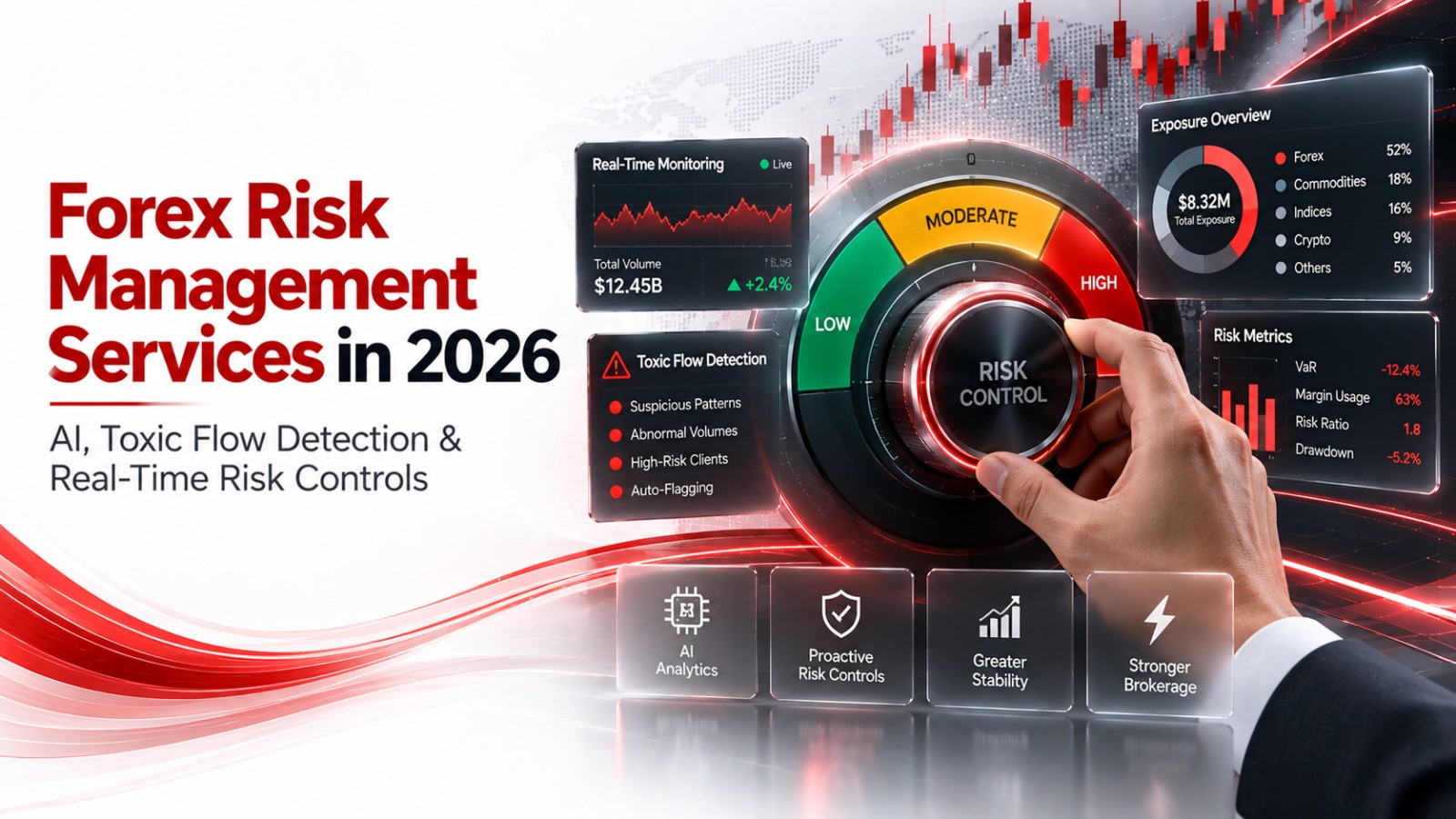
Forex brokers operate in an increasingly complex trading environment where market volatility, fast execution, liquidity fragmentation, and sophisticated trading strategies can create significant risk. In 2026, traditional risk controls are no longer enough. Brokers need intelligent systems that can identify abnormal trading behaviour, monitor exposure in real time, and automatically respond before losses escalate.
Modern Forex Risk Management Services are therefore evolving around three core capabilities: artificial intelligence, toxic flow detection, and real-time risk controls. Together, these technologies help brokers manage exposure, improve execution quality, protect liquidity relationships, and build more resilient trading infrastructure.
Why Forex Broker Risk Management Is Changing in 2026
Forex brokers face risks that can develop within milliseconds. Sudden market movements, excessive client exposure, latency arbitrage, toxic flow, liquidity-provider changes, and technology failures can all affect profitability and execution.
In 2026, brokers are increasingly moving from reactive monitoring toward automated, data-driven risk management. Instead of relying solely on static limits and manual intervention, modern platforms continuously analyse trading activity and adjust controls according to current conditions.
This shift is increasing demand for Advanced Forex Risk Management Solutions that combine exposure monitoring, automated controls, analytics, and execution intelligence in a single infrastructure.
What Are Forex Risk Management Services?
Forex Risk Management Services encompass the technologies, systems, and processes brokers use to identify, measure, control, and mitigate trading and operational risks.
These services can include real-time exposure monitoring, margin and position controls, toxic flow analysis, automated hedging, liquidity management, pre-trade checks, and risk reporting.
A modern FX Trading Risk Management Software platform can connect trading servers, liquidity providers, bridges, CRM systems, and other broker infrastructure. This creates a central risk layer where positions, exposure, execution, and client behaviour can be monitored continuously.
How AI Is Transforming Forex Broker Risk Management
Artificial intelligence is becoming an important component of modern broker risk infrastructure. AI systems can process large volumes of trading data and identify relationships that may be difficult to detect using conventional rule-based systems.
For example, AI can analyse client trading frequency, order timing, profitability, execution patterns, instrument preferences, and historical behaviour. These insights can support dynamic risk classification and help brokers identify unusual activity earlier.
However, AI works most effectively when combined with clearly defined risk rules and human oversight. It should enhance decision-making rather than replace fundamental controls.
AI-Powered Toxic Flow Detection
Toxic flow refers broadly to trading activity that can create adverse selection or increased risk for a broker or liquidity provider. Detecting such activity quickly is particularly important for brokers operating with external liquidity providers.
AI-powered toxic flow detection can analyse trading patterns across multiple dimensions, including latency, order timing, profitability, holding periods, execution behaviour, and market conditions.
Instead of applying identical treatment to every client, intelligent systems can identify behavioural patterns and assign risk profiles. This allows brokers to investigate potentially problematic flow, adjust routing strategies, or modify hedging decisions based on evidence.
The objective is not simply to identify profitable clients, but to understand which trading behaviours may create execution or liquidity risk.
Real-Time Exposure Monitoring & Risk Analytics
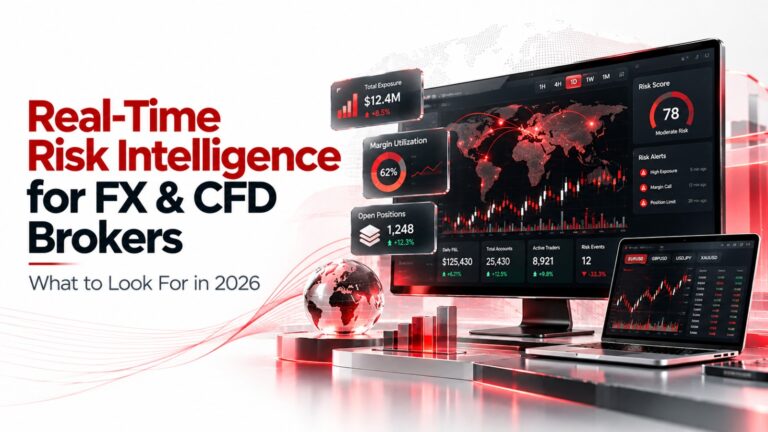
Real-time visibility is fundamental to modern real-time forex risk monitoring. Brokers need to understand their net exposure by client, instrument, currency, account group, and liquidity provider.
A real-time risk engine can consolidate these positions and provide a continuously updated view of exposure. Dashboards can highlight concentration, margin utilisation, unusual position changes, and potential risk thresholds.
Advanced analytics can also support scenario analysis, allowing risk teams to examine how positions could behave under different market conditions.
Automated Pre-Trade Risk Controls
Pre-trade controls help brokers evaluate orders before they enter the market. Automated checks can validate parameters such as account permissions, available margin, maximum order size, exposure limits, instrument restrictions, and other predefined rules.
Pre-trade risk controls can reduce the need for manual intervention while helping prevent orders that violate established risk policies.
This is an important part of automated forex risk management, particularly for brokers handling high order volumes where manual review would create execution delays.
Automated Hedging & Dynamic Exposure Management
Automated hedging allows brokers to respond to changing exposure without depending entirely on manual decisions. When client positions create significant net exposure, systems can trigger hedging actions according to predefined strategies.
Modern automated hedging forex solutions can consider exposure, liquidity, market conditions, instrument correlations, and risk thresholds when determining how and when to hedge.
Dynamic exposure management can also change limits or hedging behaviour as market conditions evolve, helping brokers avoid relying on static thresholds during periods of heightened volatility.
Smart Liquidity Routing & Slippage Control
Liquidity management is closely connected to risk management. Brokers often work with multiple liquidity providers, each offering different spreads, depth, execution characteristics, and availability.
Smart routing can analyse available liquidity and direct orders according to configured execution and risk parameters. Smart order routing forex technology can therefore contribute to both execution quality and exposure management.
Slippage monitoring is equally important. By analysing requested versus executed prices, brokers can identify recurring execution issues and assess liquidity-provider performance.
DORA and the Growing Focus on Operational Resilience
Operational resilience is becoming an increasingly important part of financial technology infrastructure. European brokers and financial entities affected by the Digital Operational Resilience Act (DORA) need stronger approaches to ICT risk, incident management, testing, and third-party technology oversight.
For brokers, this means risk management cannot focus exclusively on trading positions. Technology availability, infrastructure dependencies, cybersecurity processes, incident response, and business continuity also matter.
DORA forex broker requirements therefore reinforce the broader movement toward resilient and continuously monitored infrastructure.
MT4 to MT5: The Impact on Broker Risk Infrastructure
The transition between MetaTrader environments can have implications beyond the trading interface. MT4 MT5 risk management requires brokers to consider how risk engines, bridges, liquidity connections, execution logic, and monitoring systems interact with the selected platform.
For brokers undertaking MT4 to MT5 migration, maintaining consistent risk controls throughout the transition is critical. Exposure monitoring, order validation, hedging workflows, and liquidity connectivity should be tested across the new infrastructure before full deployment.
What Forex Brokers Should Look for in a Risk Management Provider
Brokers evaluating a risk technology provider should consider several capabilities:
- Real-time exposure and position monitoring
- AI-assisted behavioural and toxic-flow analysis
- Automated pre-trade controls
- Dynamic risk limits and exposure management
- Automated hedging capabilities
- Multi-LP liquidity monitoring
- Smart routing and execution analytics
- MT4 and MT5 compatibility
- Detailed reporting and audit trails
- Scalable architecture and operational resilience
The right solution should integrate with existing broker infrastructure rather than create another isolated system.
How FXDS Supports Modern Forex Broker Risk Management
FXDS provides technology designed to support modern broker risk-management requirements, combining risk monitoring, exposure management, liquidity infrastructure, and automated controls.
Its approach aligns with the industry’s shift toward real-time analytics and intelligent automation. By connecting trading activity with risk and liquidity intelligence, brokers can gain greater visibility into exposure, client behaviour, execution, and hedging requirements.
As broker infrastructure becomes more interconnected in 2026, a centralised risk-management layer can help organisations respond to changing market conditions while maintaining consistent controls.
FAQs
Q1. What are Forex Risk Management Services?
They include technologies and processes used to monitor and control trading exposure, liquidity risk, client behaviour, execution risk, and operational risks for forex brokers.
Q2. How does AI help forex risk management?
AI can analyse large volumes of trading data to identify unusual behavioural patterns, classify risk, detect potentially toxic flow, and support dynamic risk decisions.
Q3. What is toxic flow detection?
Toxic flow detection identifies trading behaviours that may create adverse selection, execution problems, or increased exposure for brokers and their liquidity providers.
Q4. Why are real-time risk controls important?
Real-time controls allow brokers to identify exposure changes and enforce predefined limits quickly, reducing dependence on delayed reporting or manual intervention.
Q5. What should brokers look for in risk management software?
Brokers should consider real-time monitoring, automated controls, toxic-flow analytics, hedging, liquidity connectivity, execution analytics, scalability, and MT4/MT5 compatibility.
Q6. How does automated hedging work?
Automated hedging systems monitor exposure and can execute predefined hedging actions when specific risk thresholds or market conditions are reached.
Q7. Is MT5 changing broker risk infrastructure?
MT5 migration can affect trading connectivity, risk engines, liquidity bridges, execution workflows, and monitoring systems, making infrastructure planning important during migration.