
FX and CFD brokers operate in an environment where exposure can change within seconds. Client positions accumulate, leverage amplifies market movements, liquidity conditions shift, and correlated instruments can create concentrations that are difficult to identify through periodic reporting.
For a broker managing multiple platforms, liquidity providers, instruments, and client segments, delayed risk information can become a serious operational weakness.
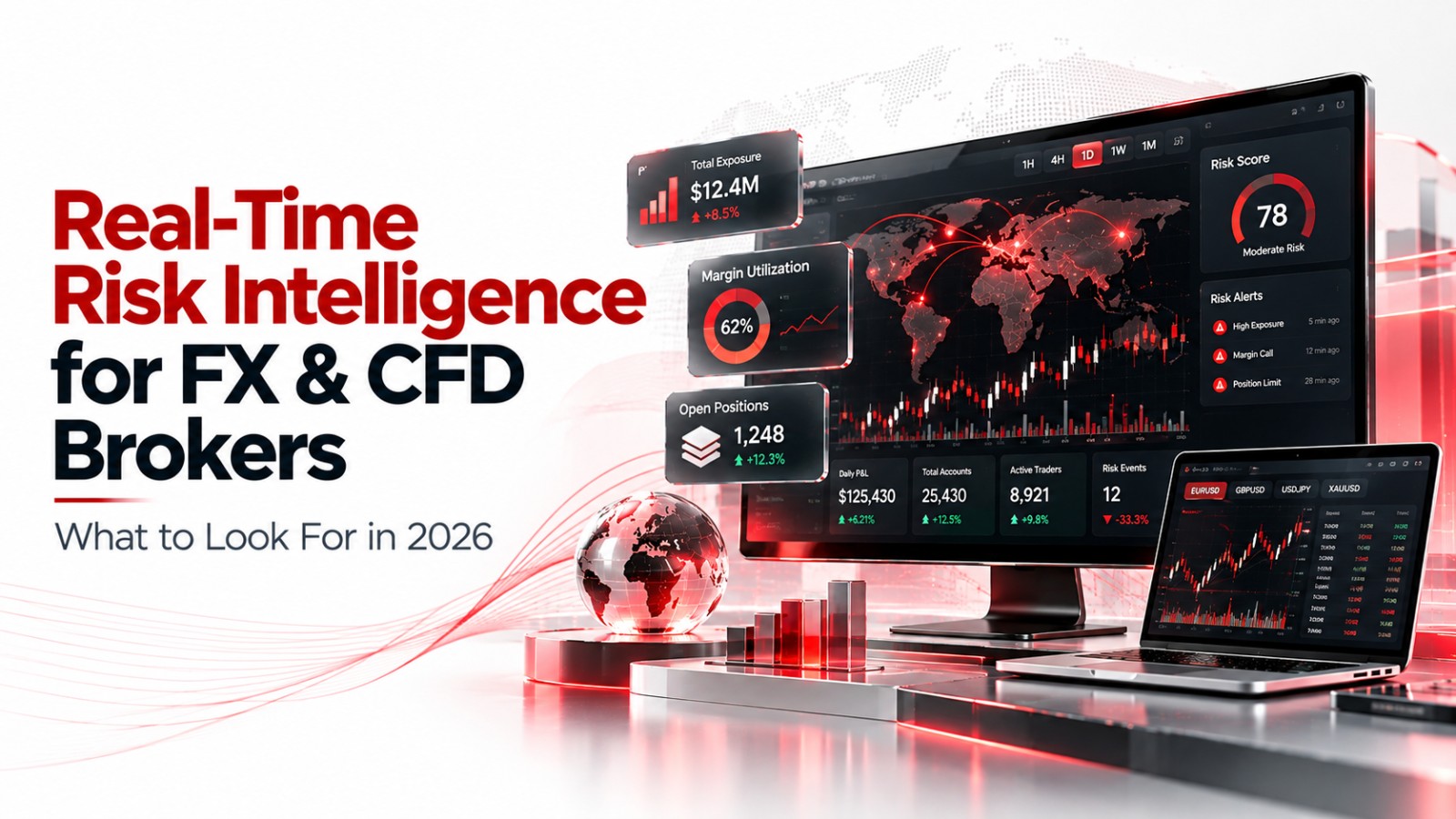
This is why real-time risk intelligence is becoming more than a reporting capability in 2026. Modern platforms combine live trading data, exposure analytics, client behaviour, margin monitoring, liquidity information, automated alerts, and increasingly AI-assisted analysis into a single risk environment.
The challenge is determining which capabilities actually provide useful intelligence rather than another dashboard filled with data.
What Is Real-Time Risk Intelligence?
Real-time risk intelligence refers to the continuous collection, processing, and analysis of trading and market data to identify changes in a broker’s risk profile as they occur.
For FX and CFD brokers, this can include:
Client and aggregate positions
Gross and net exposure
Margin utilisation
Leverage
Realised and unrealised P&L
Instrument concentration
Client profitability
Trading behaviour
Liquidity conditions
Execution activity
Risk-limit utilisation
The distinction between data visibility and risk intelligence is important. A system that simply displays positions is not necessarily providing intelligence. The stronger platforms identify relationships, highlight abnormal changes, and direct the risk team toward situations requiring intervention.
1. Real-Time Exposure Visibility
Exposure is one of the first areas to evaluate. A broker needs visibility across individual clients, client groups, instruments, currencies, and the overall trading book. Net exposure alone is insufficient because offsetting positions can conceal substantial gross exposure.
The platform should provide:
Gross exposure
Net exposure
Long/short ratios
Position concentration
Exposure by instrument
Exposure by client
Exposure by currency
Changes in exposure over time
For brokers managing high trading volumes, broker exposure management software can provide a consolidated view of positions, margin, P&L, concentration, and exposure across the trading environment.
2. Multi-Asset Risk Monitoring
FX and CFD brokers increasingly operate across currencies, indices, commodities, metals, equities, and other instruments. Adding asset classes also increases the number of relationships that risk teams need to monitor. A risk intelligence platform should therefore support a multi-asset environment rather than treating each instrument in isolation.
Cross-asset monitoring can identify:
Concentrated exposure
Correlated positions
Directional risk
Margin pressure
Large client positions
Rapid changes in trading activity
This becomes particularly important when the same client or client group holds positions across several correlated instruments.
3. Integration With Trading and Liquidity Infrastructure
A risk intelligence platform is only as useful as the data it receives. FX and CFD brokers may operate MT4, MT5, proprietary platforms, liquidity bridges, CRM systems, order management systems, and multiple liquidity-provider connections. The risk layer should therefore integrate with the broker’s existing infrastructure rather than create another isolated data source.
Integration requirements can include:
MT4 and MT5 connectivity
Trading-platform APIs
Liquidity-provider feeds
Bridge connectivity
CRM data
Order data
Market data
Position and account information
The goal is to create a consistent risk picture across the brokerage rather than forcing risk teams to reconcile information from disconnected systems.
4. Client Behaviour and Concentration Analysis
Exposure does not exist independently of client behaviour. A broker may have several clients trading the same instrument in the same direction, creating aggregate exposure that is not obvious from individual account monitoring.
A useful intelligence platform should allow risk teams to identify:
Large individual positions
Client concentration
Directional client behaviour
Rapid position accumulation
Unusual trading volumes
Significant P&L changes
Changes in trading patterns
This moves risk monitoring beyond basic position reporting and toward understanding who is creating the exposure and how that exposure is changing.
5. Margin, Leverage and P&L Intelligence
Margin utilisation can change rapidly when leveraged positions move against clients. A platform should provide real-time visibility into used margin, available margin, equity, leverage, and P&L alongside exposure.
These metrics become more useful when analysed together.
For example, rapidly increasing directional exposure combined with rising leverage and deteriorating client equity represents a different risk scenario from a similar exposure supported by substantial available margin.
The platform should allow risk teams to move from the aggregate metric to the underlying accounts, instruments, and positions responsible for the change.
6. Automated Alerts and Risk Thresholds
Real-time intelligence should reduce the dependence on constant manual monitoring.
Automated alerts can identify conditions such as:
Exposure approaching a predefined limit
Margin utilisation increasing rapidly
Large position accumulation
Unusual client activity
Significant P&L movements
Instrument concentration
Changes in liquidity conditions
The quality of the alerting system matters as much as the number of alerts it generates.
Excessive low-value alerts can create alert fatigue and cause genuine risk events to receive less attention. Effective systems should prioritise events according to severity, threshold utilisation, exposure size, and other relevant risk indicators.
7. AI-Assisted Risk Intelligence
AI is becoming an additional analytical layer within risk technology in 2026. Traditional risk systems generally operate around predefined rules. For example, an alert can be triggered when exposure exceeds a specific threshold. AI can complement these rules by analysing larger datasets and identifying patterns that may not be immediately visible through static thresholds.
Potential applications include:
Anomaly detection
Behavioural pattern recognition
Unusual position accumulation
Trading-frequency changes
Correlated client activity
Automated risk summaries
Emerging exposure patterns
AI should enhance established risk policies rather than replace them. Risk teams still need transparent thresholds, reliable source data, defined escalation procedures, and human oversight. Current FXDS risk analytics content similarly positions AI as a complement to rule-based controls rather than a replacement for them.
8. Execution and Liquidity Intelligence
Risk cannot be separated completely from execution. A broker may have acceptable exposure levels while still facing execution or liquidity problems that increase the cost of managing that exposure.
Risk intelligence should therefore provide context around:
Liquidity availability
Execution conditions
Spread changes
Hedge requirements
Order flow
Liquidity-provider connectivity
A-Book and B-Book exposure
Connecting liquidity and risk information can help dealing teams understand not only how much exposure exists, but also how practical it is to hedge or manage that exposure. This is particularly relevant for brokers operating multiple liquidity sources or hybrid execution models.
9. Scalability and Data Processing
A risk platform that works for a small brokerage may not perform adequately as trading activity increases. The evaluation should therefore cover data-processing capacity, response times, account volumes, instrument coverage, historical data, and the ability to process high-frequency trading events without significant delays.
The platform should maintain performance as the broker adds:
Clients
Trading volume
Instruments
Liquidity providers
Trading platforms
Geographic markets
Scalability is not simply a technology consideration. If risk data becomes delayed as trading volume grows, the broker can lose visibility precisely when the exposure profile becomes more complex.
10. Actionability, Controls and Workflow
The final evaluation should focus on what happens after a risk signal appears.
A platform should help risk teams move from:
Detection → Investigation → Decision → Action
For example, an exposure alert should lead to the underlying client or instrument, show the relevant positions and P&L, provide context around the exposure, and support the next risk-management decision.
Integration with pre-trade controls, hedging systems, dealing workflows, and risk limits can make intelligence actionable rather than purely informational.
This is where real-time trading risk analytics fits into the wider technology architecture: analytics identify what is changing, while connected controls and workflows determine how the broker responds.
Where Forex Risk Management Services Fit
Not every broker has the internal resources to build and operate a sophisticated risk intelligence environment. Technology is only one part of the equation. Risk policies, exposure monitoring, dealing workflows, liquidity management, and ongoing analysis also require appropriate expertise.
For brokers that need broader support, forex risk management services can complement technology through risk analytics, dealing-room support, platform connectivity, and related operational capabilities.
The requirement should be assessed according to the broker’s internal risk team, trading volume, execution model, asset coverage, and level of automation.
A Practical Evaluation Framework
Before selecting a real-time risk intelligence platform, brokers should score each solution across five areas:
| Evaluation Area | Key Requirements |
|---|---|
| Data | Real-time feeds, accurate aggregation, historical data |
| Risk | Exposure, margin, P&L, concentration, limits |
| Intelligence | Alerts, anomaly detection, behavioural analysis, AI |
| Integration | MT4/MT5, APIs, liquidity, CRM, trading systems |
| Actionability | Risk workflows, controls, hedging and escalation |
The strongest platform is not necessarily the one with the largest feature list. It is the one that delivers reliable data, meaningful risk signals, and practical workflows without creating another disconnected layer in the brokerage infrastructure.
Conclusion
For FX and CFD brokers, real-time risk intelligence is increasingly becoming a core component of brokerage infrastructure.
The evaluation should go beyond dashboard design and feature count. Brokers need to examine data quality, real-time exposure visibility, multi-asset monitoring, client behaviour analysis, margin and P&L intelligence, automated alerts, AI capabilities, liquidity context, scalability, and integration with existing trading systems.
The risk of choosing the wrong platform is not simply paying for unused features. A fragmented or delayed risk environment can leave exposure undetected, slow the response to market events, and make a growing brokerage increasingly difficult to control.
In 2026, the stronger approach is to evaluate risk intelligence as an operational layer connecting trading data, exposure analysis, liquidity, automation, and decision-making.
For brokers assessing technology partners, FXDS can be evaluated against these same criteria, particularly where real-time exposure monitoring, risk analytics, liquidity management, and connected risk workflows are required.
Frequently Asked Questions
Q1. What is real-time risk intelligence for FX and CFD brokers?
Real-time risk intelligence continuously analyses trading, exposure, margin, P&L, client behaviour, liquidity, and execution data to give brokers a current view of their risk position. Unlike periodic reporting, it helps risk teams identify material changes and potential issues as they develop.
Q2. What should FX and CFD brokers look for in a real-time risk intelligence platform?
Key capabilities include real-time exposure monitoring, gross and net exposure analysis, margin and P&L visibility, client behaviour analysis, concentration monitoring, automated alerts, liquidity intelligence, API integrations, and AI-assisted anomaly detection. Scalability and integration with existing trading and liquidity infrastructure are also critical.
Q3. What’s the best real-time risk intelligence for FX and CFD brokers?
The best real-time risk intelligence platform depends on the broker’s trading model, asset coverage, client volume, liquidity structure, and risk-management requirements. A suitable platform should combine real-time exposure analytics, client and position monitoring, margin visibility, alerts, liquidity context, and actionable risk workflows rather than simply providing a reporting dashboard. FXDS can be evaluated against these requirements where brokers need integrated risk analytics, exposure monitoring, and liquidity-related risk intelligence.
Q4. How does real-time risk intelligence help brokers manage client exposure?
It gives risk teams continuous visibility into individual and aggregate positions, gross and net exposure, concentration, margin utilisation, and P&L. Automated alerts can identify rapidly increasing exposure or threshold breaches, allowing the broker to investigate and respond before the risk becomes more difficult to control.
Q5. Can AI improve risk intelligence for FX and CFD brokers?
AI can enhance risk intelligence by identifying unusual trading patterns, behavioural anomalies, changing exposure profiles, and relationships across large volumes of trading data. It works most effectively alongside established risk limits, rule-based alerts, and human oversight rather than replacing the broker’s existing risk controls.