
The global forex market handles trillions of dollars in transactions every day, making it one of the fastest-moving and most liquid financial markets. Currency values can shift instantly in response to economic data releases, central bank decisions, geopolitical events, and changing liquidity conditions. For brokers, maintaining control over market exposure is critical to protecting profitability and ensuring long-term business stability.
Traditional risk management approaches often depend on manual processes, delayed reporting, and disconnected systems that are not designed for today’s high-speed trading environment. As market complexity increases, many firms are turning to Advanced Forex Risk Management Solutions that provide real-time visibility into exposure, automate key risk controls, and support faster decision-making.
Modern broker risk management platforms leverage automation, advanced analytics, and intelligent monitoring tools to help brokers identify potential risks early, respond efficiently to market changes, and maintain greater operational control across their trading infrastructure.
Why Real-Time Risk Monitoring Matters in Forex Trading
Market volatility remains one of the biggest challenges for forex brokers. Major currency pairs can move 1–3% in a single trading session following high-impact economic announcements or unexpected geopolitical events. Without continuous exposure visibility and Real-Time Risk Analytics for Forex Brokers, firms may struggle to identify growing risks before they impact profitability.
Exposure accumulation further increases the challenge. During strong market trends, clients often open positions in the same direction, creating significant concentration risk that may go unnoticed with delayed reporting systems.
Historical events highlight the importance of proactive risk management. The GBP flash crash of 2016 saw the pound fall nearly 10% within minutes, while the 2015 Swiss franc crisis triggered substantial losses across the brokerage industry. Brokers equipped with real-time monitoring and automated hedging were far better positioned to reduce exposure and respond effectively during these extreme market conditions.
Key Risks Faced by Forex Brokers
Market Risk: Market risk arises when adverse price movements affect open positions. Brokers carrying net exposure can experience losses if markets move sharply against their positions. Effective trading risk management requires continuous monitoring of price fluctuations and overall exposure.
Liquidity Risk: Liquidity providers may widen spreads or reduce available liquidity during volatile conditions. This can impact execution quality and increase trading costs. Monitoring liquidity conditions in real time helps brokers maintain stable operations.
Counterparty Risk: Brokers rely on liquidity providers, prime brokers, and technology partners. Failure of any critical counterparty can expose the business to unexpected risks and operational disruptions.
Client Exposure Risk: Client trading activity often becomes concentrated around specific market trends or events. Large directional exposure across multiple accounts can create substantial risk if not identified early.
Operational Risk: System failures, bridge connectivity issues, server instability, and human errors can all contribute to losses. Effective broker risk management must address both trading and operational risks simultaneously.
What Are Advanced Forex Risk Management Solutions?
Advanced forex risk management solutions are integrated platforms that monitor, analyse, and respond to broker risk exposure continuously without waiting for end-of-day reconciliation or manual review.
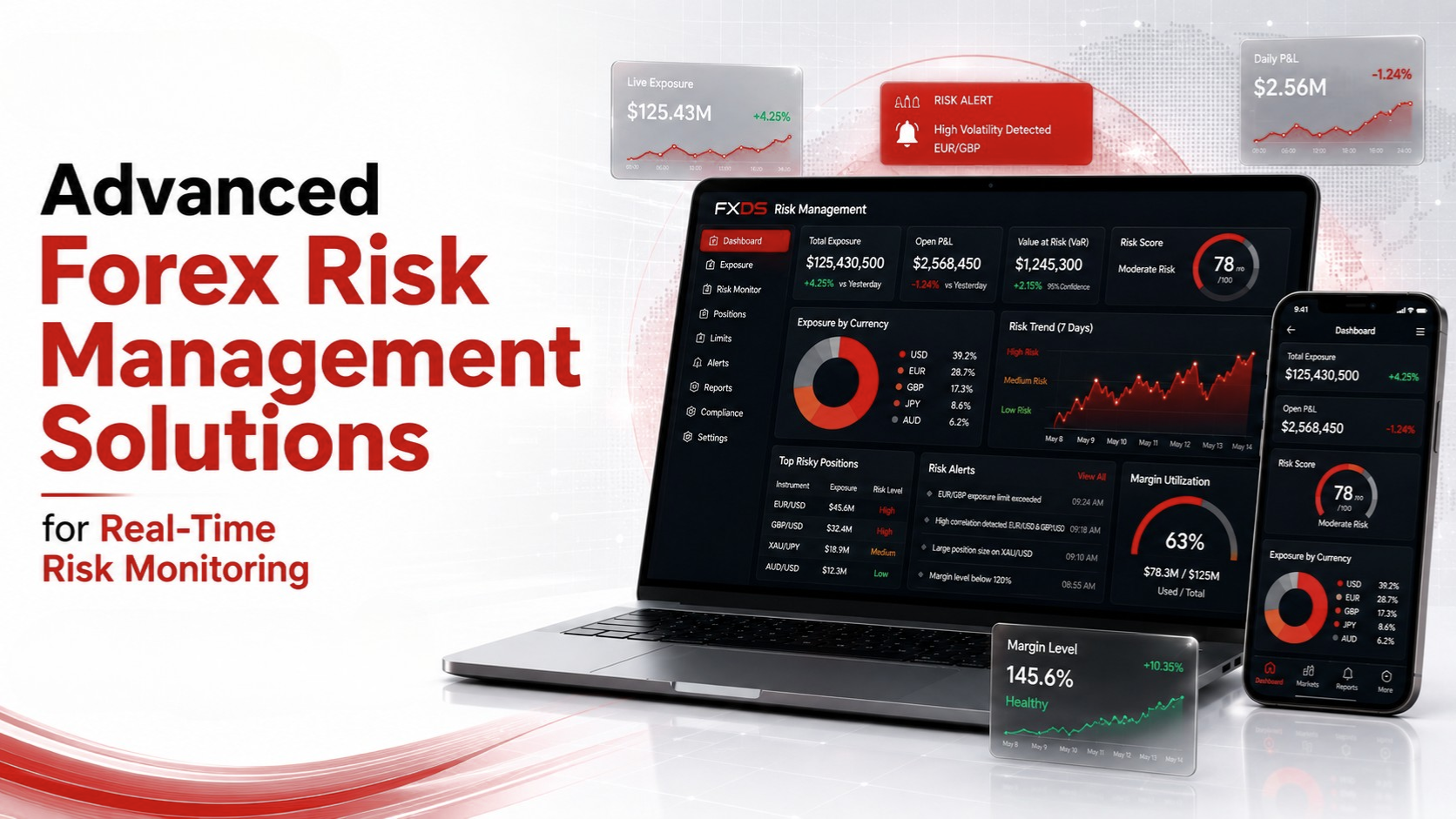
A modern forex risk management platform combines automated risk engines, exposure monitoring across client groups and instruments, hedging automation, and AI-powered alerts that detect anomalous patterns early. The best exposure management software ties all of this into a single workflow from trade entry through risk response.
Core Features of Modern Forex Risk Management Software
- Real-Time Exposure Monitoring: Live net and gross exposure across all instruments and client groups, updated tick by tick rather than on a batch schedule.
- Automated Hedging: Rule-based execution of cover trades when thresholds are breached, removing dealer latency from the most time-sensitive part of the risk workflow.
- Liquidity Bridge Integration: Direct monitoring of bridge connectivity, fill quality, and spread conditions. Bridge performance belongs inside the risk picture.
- AI-Powered Risk Alerts: Pattern recognition that flags unusual position accumulation, correlated account activity, and potential toxic flow before exposure becomes a problem.
- Position Monitoring Dashboard: A unified dealing desk view covering all open positions, P&L, hedging activity, and client exposure with account-level drill-down.
- Multi-Asset Risk Management: A single framework covering FX, metals, indices, commodities, and crypto.
- MT4 and MT5 Integration: Native integration with both MetaTrader platforms including real-time position feeds, group and symbol-level configuration, dealer plugin access, and server performance monitoring.
How Real-Time Risk Monitoring Works
A well-structured risk workflow runs like this:
Trader Places Order → Trading Platform (MT4/MT5) → Risk Engine → Exposure Analysis → Alert Generation → Automated Hedging → Reporting Dashboard
The delay between a position opening and its appearance in the risk picture should be milliseconds, not minutes. Where hedging is required, execution follows automatically according to pre-configured rules, with dealer oversight reserved for exceptions.
AI and Machine Learning in Forex Risk Monitoring
AI is where early movers are building genuine competitive advantages. Predictive risk analytics uses historical position data and market patterns to forecast elevated risk periods before they materialise, allowing the risk desk to tighten thresholds ahead of known risk windows.
Abnormal trading detection flags suspicious patterns, sudden large positions, timing close to news events, or activity correlating with market-moving information. The direction of travel is toward adaptive, self-adjusting risk parameters that respond to market conditions in real time.
Advanced Forex Risk Management Solutions for MT4 and MT5 Brokers
Most retail brokers operate on MetaTrader, and risk management that does not integrate natively creates expensive gaps under pressure. MT4 exposure management requires a risk engine reading position data directly from the server, applying group and symbol-level rules without latency. MT5 involves a different position model, so brokers migrating platforms need to rebuild their risk configuration correctly rather than copying it across.
MT4 MT5 server setup and management is not separate from risk management. Server instability during volatile periods creates risk engine blind spots. Bridge performance monitoring, dealer intervention tools, and server health all belong inside the risk workflow.
How FXDS Helps Brokers Manage Risk in Real Time
FXDS provides advanced forex risk management solutions built around the operational reality of running a retail or institutional brokerage. The offering covers real-time exposure monitoring, automated risk alerts configured to each broker’s thresholds, and real-time risk analytics for forex brokers that translate raw position data into the metrics risk managers actually use.
MT4 and MT5 integration is native covering position feeds, server management, dealing desk tools, and bridge performance monitoring. FXDS works with each broker to develop customised risk strategies that reflect their business model and regulatory requirements.
Conclusion
The forex industry has evolved dramatically, and risk management practices must evolve alongside it. Manual processes and delayed reporting are no longer sufficient for brokers operating in fast-moving global markets.
Modern Advanced Forex Risk Management Solutions provide the technology needed to monitor exposure continuously, automate hedging decisions, improve liquidity management, and strengthen operational resilience. Combined with AI-powered analytics and real-time monitoring, these platforms enable brokers to reduce risk, improve profitability, and maintain stability across all market conditions.
For growing brokerages, investing in robust Forex risk management software is not simply a defensive measure, it is a strategic advantage that supports sustainable business growth.
Frequently Asked Questions
Q1. What is forex risk management?
Forex risk management refers to the processes, technologies, and strategies used by brokers to identify, monitor, and control financial and operational risks arising from trading activity, liquidity conditions, and counterparty relationships.
Q2. Why is real-time risk monitoring important?
Real-time monitoring provides immediate visibility into exposure, allowing brokers to identify risks early and respond before losses accumulate. It significantly improves decision-making during volatile market conditions.
Q3. How does automated hedging reduce broker exposure?
Automated hedging executes protective trades automatically when predefined exposure thresholds are reached. This removes delays associated with manual intervention and ensures consistent risk control.
Q4. Can MT4 and MT5 support advanced risk management tools?
Yes. Native integration with MT4 and MT5 allows brokers to access real-time position feeds, automated hedging, dealer controls, exposure monitoring, and advanced reporting capabilities.
Q5. What benefits does AI provide in risk management?
AI improves risk management by identifying abnormal trading patterns, forecasting potential risk events, detecting toxic flow, and providing predictive analytics that support proactive decision-making.
Q6. How do brokers manage liquidity risk?
Liquidity risk is managed through continuous monitoring of liquidity providers, intelligent order routing, bridge performance monitoring, and maintaining relationships with multiple liquidity sources.
Q7. What should brokers look for in a risk management provider?
Key factors include scalability, real-time monitoring capabilities, MT4/MT5 integration, automated hedging functionality, AI-driven analytics, regulatory reporting features, liquidity monitoring, and 24/7 support.