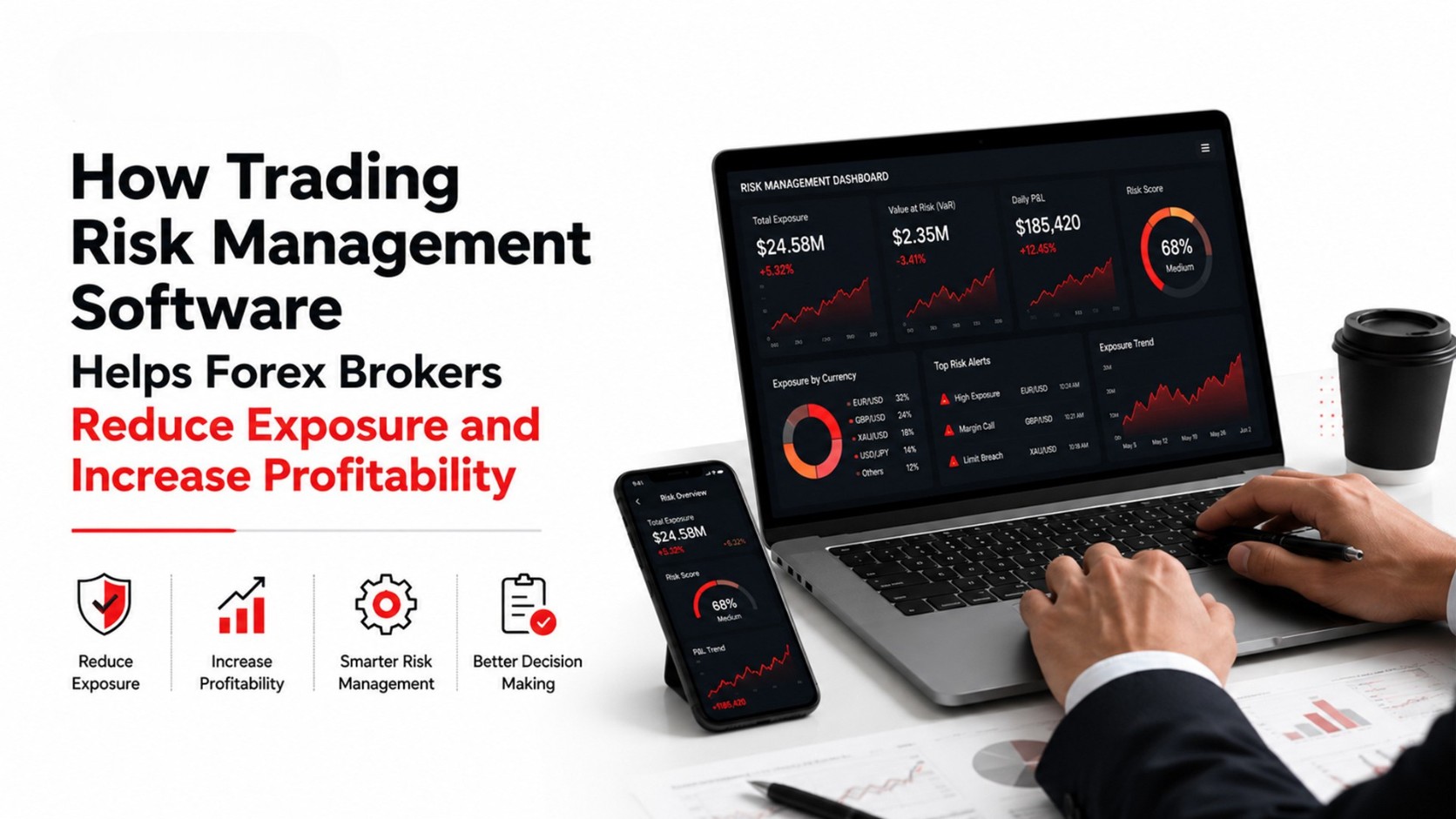
Forex brokers operate in one of the most unforgiving financial environments on the planet. Prices shift in milliseconds, client behaviour evolves without warning, and liquidity conditions can reverse overnight. In this landscape, unmanaged exposure is not a temporary inconvenience it is a direct threat to revenue, stability, and long-term growth.
The most successful brokerages in 2026 understand that profitability is not built on client volume alone. It is built on intelligent, automated risk infrastructure. That is why trading risk management software has become an essential pillar of modern brokerage operations, not a nice-to-have, but a non-negotiable strategic asset.
What Is Trading Risk Management Software?
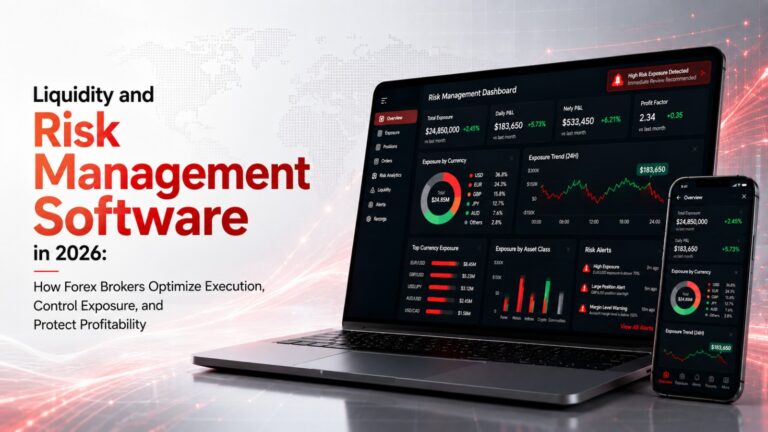
The trading risk management software is a specialised platform that enables forex brokers to monitor, analyse, and control live trading exposure in real time. It automates risk alerts, enforces pre-trade controls, and delivers actionable analytics all designed to protect broker profitability and ensure 24/5 operational stability.
Rather than reacting to losses after they occur, brokers using advanced risk management analytics tools can identify exposure problems before they escalate into financial damage. This shift from reactive to proactive risk oversight is what separates profitable brokerages from those constantly playing catch-up.
Why Forex Brokers Need Dedicated Risk Management Software in 2026
The forex market has outgrown manual monitoring. Spreadsheets, delayed reports, and human-only oversight create dangerous blind spots in fast-moving conditions. Brokers that rely on legacy risk processes face three compounding problems: growing exposure risk, compliance pressure, and revenue leakage.
Several industry shifts are accelerating the move toward dedicated risk platforms:
AI-Powered Risk Modelling: Machine learning algorithms now detect toxic trading patterns, unusual client behaviour, and concentrated exposure in real time, far faster than human analysts can.
Real-Time Analytics Requirements: Regulatory expectations and liquidity provider relationships increasingly demand instant visibility into position data, client flow, and P&L metrics. Periodic reporting is no longer sufficient.
Rising Operational Costs: Building an in-house dealing desk requires substantial investment in staffing, infrastructure, and ongoing training. Outsourced dealing room solutions and specialised software platforms now deliver institutional-grade monitoring at a fraction of that cost.
MT4/MT5 Ecosystem Demands: MetaTrader remains the dominant trading infrastructure globally. Risk systems must integrate seamlessly with MT4/MT5 servers, bridge providers, liquidity aggregators, and various execution model configurations. Without native integration, brokers operate with incomplete data and delayed decision-making.
How Trading Risk Management Software Reduces Exposure
FX Dealing Solutions (FXDS) was founded by a team of experienced and certified financial services professionals to provide brokers worldwide with a reliable, transparent, and dynamic forex risk management solution. Their framework operates around the clock, giving brokers unique insight into trader behaviour and unrivalled context on risk all designed to improve operational efficiency.
Here is how modern trading risk management solutions help reduce exposure across the trade lifecycle:
Real-Time Position Monitoring:
The system continuously tracks open positions, net exposure, client trading activity, P&L performance, and symbol-level movements. Brokers receive instant updates instead of relying on delayed manual reports.
Automated Risk Alerts:
Custom risk thresholds trigger immediate notifications when unusual trading volume, excessive drawdowns, toxic trade flow, or high exposure concentration is detected. Faster alerts enable quicker responses before risks escalate.
Pre-Trade Risk Controls:
Preventive controls are applied before orders are executed, including margin requirements, position size limits, symbol restrictions, and maximum order thresholds. Blocking excessive risk early is more effective than managing it later.
Intelligent Client Segmentation:
Not all traders present the same risk level. Advanced systems can classify traders based on behaviour and risk patterns, helping brokers make more informed trade routing and execution decisions while protecting profit margins.
MT4 and MT5 Integration:
Modern risk management platforms integrate with MetaTrader environments, bridge providers, and liquidity aggregators. This creates a unified flow of information between trade execution and risk monitoring.
Infrastructure and Platform Support:
Comprehensive solutions can also assist with server setup, liquidity connectivity, bridge integration, built-in risk tools, and hedging configurations, helping brokers build a complete trading infrastructure from the start.
24/5 Dealing Room Support:
FXDS provides professional dealing room support throughout active market sessions, from the Asia open through the New York close. A team with decades of collective industry experience monitors risk operations continuously, reducing blind spots that automated systems alone cannot cover.
How Risk Management Software Improves Broker Profitability
Risk management is often positioned as a defensive cost centre. In reality, it is one of the highest-leverage tools for increasing brokerage profitability.
The approach creates direct revenue impact by:
Reducing unexpected exposure losses before they occur
Improving trade allocation and execution accuracy
Detecting toxic flow earlier, reducing its margin impact
Lowering operational costs through automation versus manual staffing
Supporting better liquidity management decisions
Enabling brokers to tap into the genuine value of their order flow
When risk processes become automated and data-driven, broker teams spend less time reacting to problems and more time focusing on growth. That operational shift has a measurable impact on the bottom line.
Who Is FXDS Built For?
FXDS supports brokerages at every stage of growth:
Startup Brokers:
New brokerages can access advanced risk monitoring capabilities without investing heavily in internal dealing teams or costly infrastructure, reducing entry barriers and improving operational efficiency.
Small and Mid-Tier Brokers:
As trading volumes grow, scaling operations becomes more complex. Modern risk management solutions help expanding brokers handle increased exposure while controlling operational costs.
White-Label Operators:
White-label brokers require flexible systems that integrate smoothly with existing trading environments. Risk management platforms designed for compatibility with MT4 and MT5 help simplify implementation.
CTOs and Risk Managers:
Technical teams and risk managers need adaptable infrastructure that works within existing technology ecosystems. Flexible risk management solutions support seamless integration and greater operational control.
Conclusion
The future of forex brokerage profitability depends on intelligent, automated risk infrastructure. As market complexity increases and operational cost pressures grow, trading risk management software has shifted from an optional tool to a strategic business requirement.
FXDS delivers a complete risk management and dealing support ecosystem built specifically for forex brokers combining real-time analytics, MT4/MT5 integration, automated exposure controls, and professional dealing room expertise. For brokers at any stage of growth, FXDS provides the operational foundation needed to reduce exposure, improve decision-making, and protect long-term profitability.
Ready to strengthen your brokerage’s risk infrastructure? Contact FXDS today to learn how their services can work for your operation.
Frequently Asked Questions (FAQ)
Q1. What is trading risk management software?
Trading risk management software is a platform that helps forex brokers monitor, analyse, and manage live trading exposure in real time. It automates risk monitoring, enforces pre-trade controls, and detects potential threats before they affect profitability.
Q2. Why do forex brokers need risk management software in 2026?
Forex markets move at millisecond speed. Manual monitoring methods create dangerous exposure gaps. Dedicated software provides real-time visibility into positions, client flow, and P&L helping brokers make faster, better-informed decisions.
Q3. How does FXDS reduce broker exposure?
FXDS tracks open positions and client activity continuously, triggers automated alerts at configurable risk thresholds, applies pre-trade controls, and segments traders by risk profile to enable smarter routing decisions.
Q5. What is toxic trade flow in forex brokerage?
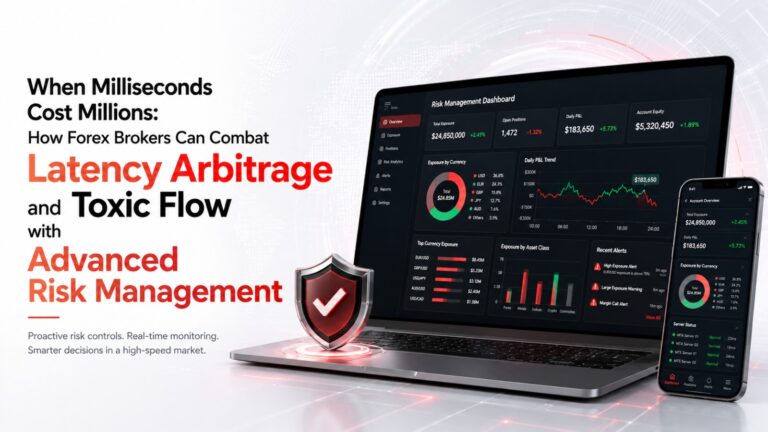
Toxic trade flow refers to trading patterns such as latency arbitrage or certain high-frequency strategies that systematically reduce broker profitability. Identifying and managing toxic flow early is critical to protecting margins.
Q6. Is FXDS compatible with MT4 and MT5?
Yes. FXDS integrates natively with MT4 and MT5 servers, bridge providers, liquidity aggregators, and various execution model configurations.
Q7. What are pre-trade risk controls?
Pre-trade controls are rules applied before an order is executed, including margin requirements, maximum position sizes, and symbol-level restrictions. They prevent excessive risk from entering the system in the first place.
Q8. Who should use FXDS risk management services?
FXDS is designed for startup brokers, small and mid-tier firms, white-label operators, dealing desks, CTOs, and risk managers who require advanced, always-on monitoring without the cost of a full in-house team.
Q9. How does FXDS dealing room support work?
FXDS provides professional dealing room oversight throughout active market sessions from the Asia open through the New York close staffed by a team with decades of collective industry experience.