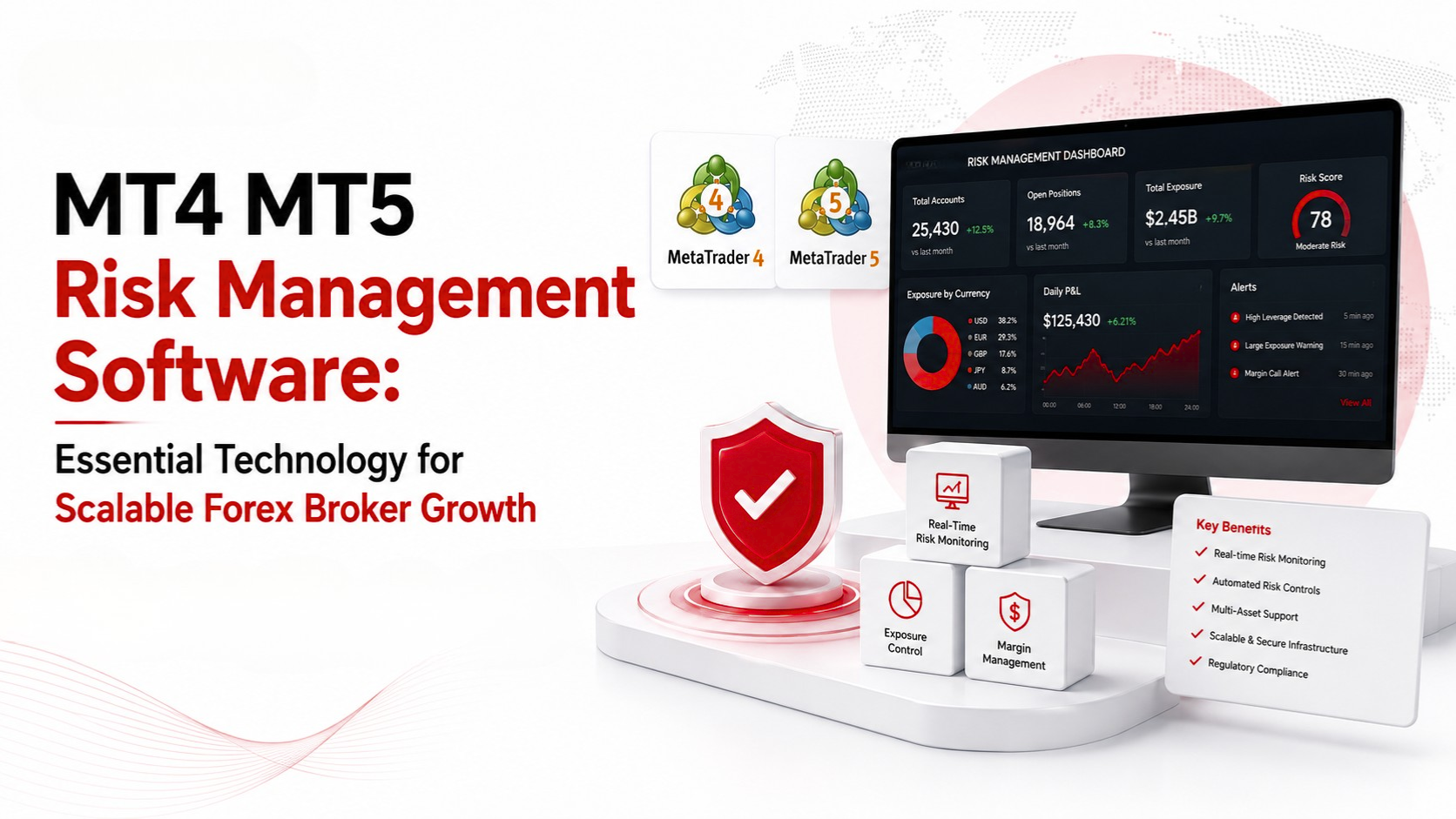
The forex brokerage industry has become increasingly competitive. Brokers are no longer competing solely on spreads, execution speed, or trading instruments. Sustainable growth now depends on how effectively a brokerage manages risk across its trading environment.
As trading volumes increase and client activity becomes more sophisticated, brokers require advanced tools that provide complete visibility into exposure, liquidity, and trading behavior. This is where MT4 MT5 Risk Management Software plays a critical role.
For modern forex brokers, risk management is not simply a back office function. It has become a core operational requirement that directly impacts profitability, liquidity stability, regulatory compliance, and long term business growth.
Why Risk Management Is Critical for Forex Brokers
Forex brokers operate in an environment where multiple risks occur simultaneously. Market volatility can trigger sharp price movements within seconds, creating significant exposure for brokers holding unhedged positions. Liquidity challenges become more pronounced during low volume trading periods or when dealing with less liquid instruments.
Another critical concern is client exposure concentration. When a large share of positions is held by a small group of traders with similar market views, the broker’s overall exposure can become heavily dependent on a single market outcome. Without real time monitoring, these risks can accumulate unnoticed. Regulatory obligations further increase the need for accurate reporting, transparency, and documented risk controls.
While risk cannot be eliminated, it can be managed effectively. The key is to measure exposure accurately, respond quickly to changing market conditions, and implement scalable risk management processes that support sustainable brokerage growth.
What Is MT4 MT5 Risk Management Software?
MT4 MT5 Risk Management Software is specialized technology designed to monitor, analyze, and control the risk generated by client trading activity across MetaTrader 4 and MetaTrader 5 environments.
The software connects directly to the MT4 and MT5 server infrastructure, providing a real time view of a broker’s overall risk exposure. It consolidates open positions, pending orders, account equity, margin levels, and net exposure across symbols, groups, and counterparties into a single dashboard.
Within a brokerage, it acts as the operational layer between the trading platform and the dealing desk, transforming trading data into actionable risk insights. Advanced solutions can automate risk responses, including hedging, alerts, and order routing. For brokers operating hybrid A Book and B Book models, the software helps determine trade allocation and manages routing to liquidity providers through integrated bridge technology, supporting both risk control and profitability.
Key Features of Modern Broker Risk Management Software
Real time exposure monitoring: forms the foundation of effective broker risk management. A professional system provides continuous visibility into net long and short positions by instrument, client group, and account type, allowing risk managers to identify growing concentrations before they become significant threats.
Automated risk alerts: reduce the need for constant manual oversight. Brokers can define thresholds for maximum exposure, drawdowns, or unusual trading activity and receive immediate notifications whenever those limits are exceeded.
Position aggregation and client segmentation: help brokers understand their true market exposure and make more informed A Book and B Book routing decisions. By directing specific client flows to external hedging while retaining offsetting positions internally, brokers can improve efficiency and profitability.
Automated hedging: further strengthens risk control by eliminating delays between risk identification and execution. When predefined conditions are met, hedging actions can be executed instantly through connected liquidity providers.
Advanced analytics: centralized dashboards, and multi server support provide a complete operational view. Risk and dealing desk teams can monitor exposure, performance metrics, and active alerts across all MT4 and MT5 servers from a single interface, improving decision making and operational efficiency.
How Risk Management Software Supports Scalable Broker Growth
The relationship between risk management technology and brokerage growth is direct and measurable. Replacing manual monitoring with automated processes improves operational efficiency, freeing risk managers to actually manage risk rather than compile reports. Live exposure data enables faster decision-making, turning what would have been reactive scrambles into managed, rule-based responses.
Better capital utilization follows from accurate exposure measurement brokers who understand their true net position can hold less precautionary capital against over-hedged positions. Reduced manual intervention decreases staffing costs and human error simultaneously. And when expansion into new markets, instruments, or account groups is on the agenda, a robust risk infrastructure scales horizontally without requiring risk processes to be rebuilt from scratch.
The scalability test is ultimately a volume test. A professional MT4 MT5 risk management platform processes tens of thousands of trades without degradation in monitoring quality or alert accuracy, a requirement no manual approach can satisfy at growth-stage volumes.
MT4 vs MT5 Risk Management Considerations
MT4 and MT5 share a trading terminal heritage but differ in ways that carry direct infrastructure implications. MT5 supports a wider range of asset classes natively, including equities, futures, and exchange traded instruments. This requires risk management software that can accurately handle cross asset correlation and margin calculations across multiple markets rather than focusing only on forex and CFDs.
MT5 also introduced a different order execution model along with netting and hedging account modes, which affect how positions are aggregated and how hedge calculations are performed. Platforms originally designed for MT4 often require substantial configuration and adaptation to operate effectively within an MT5 environment. For brokers running both platforms at the same time, which is increasingly common as firms continue supporting legacy MT4 infrastructure while expanding their MT5 offerings, a unified risk management solution across both server environments is critical for maintaining centralized visibility, consistent risk controls, and comprehensive operational oversight.
Conclusion
The forex industry continues to evolve, and brokerages must adapt to growing operational demands. Effective risk management has become a critical component of sustainable growth, profitability, and long term stability.
MT4 MT5 Risk Management Software provides the real-time visibility, automated response capability, and analytical depth that modern brokerages need to manage their books confidently and grow without proportional increases in operational risk.
FXDS delivers advanced MT4 MT5 risk management solutions, broker trading platform setup, and comprehensive MT4 MT5 server setup and management services built for the operational realities of institutional and retail forex brokerage. To learn how FXDS can strengthen your risk management infrastructure and support sustainable growth.
Frequently Asked Questions
Q1. What is MT4 MT5 Risk Management Software?
MT4 MT5 Risk Management Software is a specialized platform that connects to MetaTrader servers to monitor, analyze, and manage trading risk in real time. It aggregates client positions, tracks exposure, generates automated alerts, and supports hedging decisions, helping brokers replace manual processes with a scalable and efficient risk management framework.
Q2. Why Can’t Forex Brokers Rely on Manual Risk Management?
Manual risk management cannot keep up with today’s trading volumes and market speed. By the time exposure issues are identified through reports, market conditions may have already changed. Real time automation enables faster responses, reducing risk and improving operational control.
Q3. Does Risk Management Software Work Differently on MT4 and MT5?
Yes. MT5 supports additional asset classes, account structures, and a different server architecture compared to MT4. Risk management solutions must be configured for each platform. Brokers operating both environments benefit from a unified system that consolidates exposure across MT4 and MT5 servers.
Q4. What Should Brokers Look for in a Risk Management Platform?
Key features include real time exposure monitoring, automated hedging, A Book and B Book controls, multi server support, liquidity integration, regulatory reporting, and scalability. Strong technical expertise and ongoing support are also important factors when selecting a provider.
Q5. How Does Real Time Exposure Monitoring Protect a Brokerage?
Real time monitoring helps brokers identify risk concentrations as they emerge. This allows timely hedging, enforcement of risk limits, and better management during volatile market conditions, turning reactive risk management into a proactive process.