
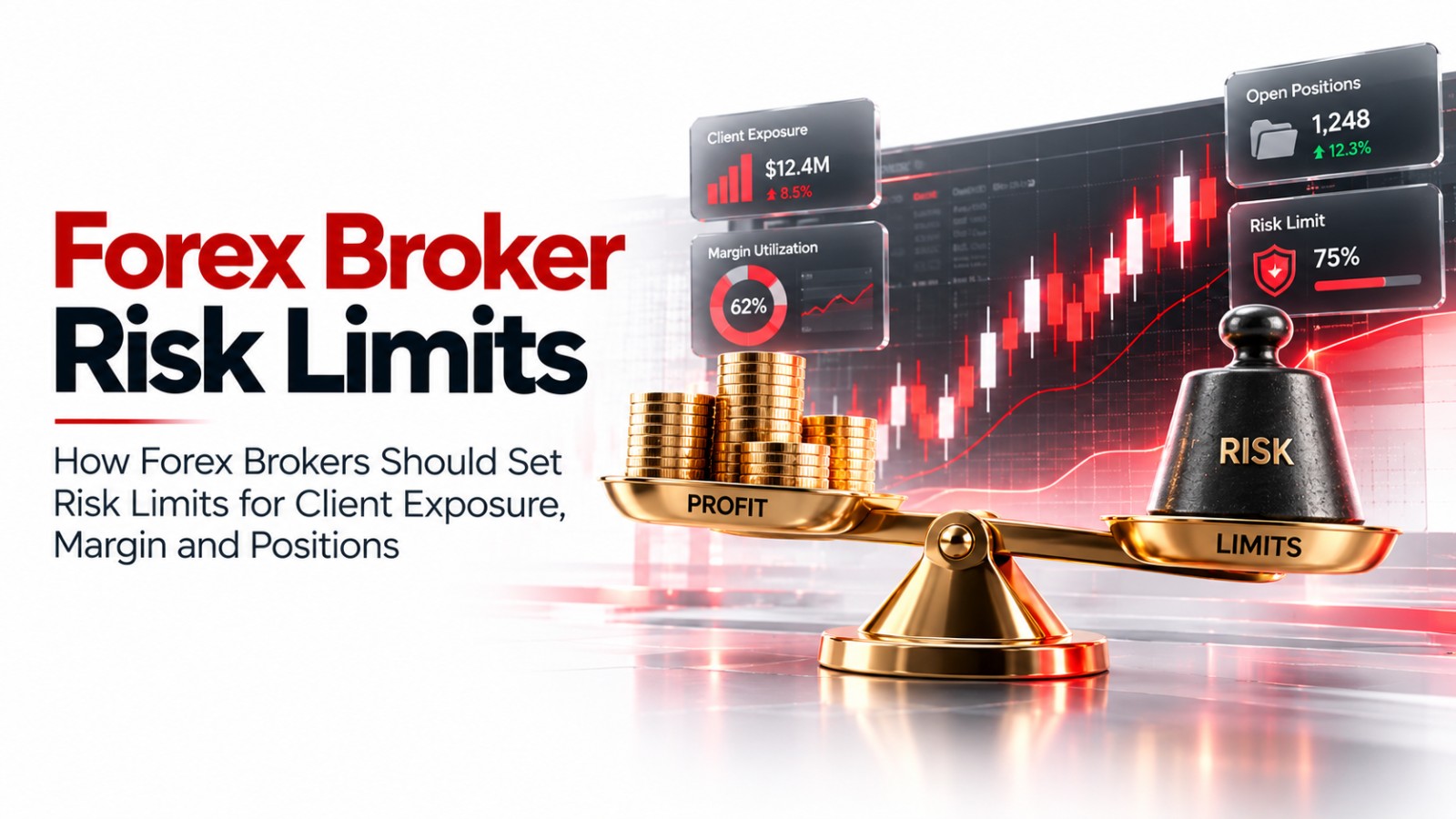
A forex broker can have strong liquidity, sophisticated trading technology, and a large client base yet remain exposed to significant losses if risk limits are poorly defined.
Client positions can accumulate quickly during volatile markets. Concentrated exposure to one currency pair can leave the broker vulnerable to sharp price movements. Excessive margin utilisation can increase liquidation risk, while unrestricted position sizes can create exposure that exceeds the broker’s available liquidity or hedging capacity.
For this reason, Forex Broker Risk Limits need to be established at multiple levels rather than treated as a single maximum exposure figure.
A robust framework should cover client exposure, margin utilisation, position size, instrument concentration, and broker-level net exposure. It should also connect those limits to real-time monitoring and automated controls.
What Are Forex Broker Risk Limits?
Forex Broker Risk Limits define the maximum level of trading exposure a broker is prepared to accept under specific conditions.
These limits can apply to individual clients, groups of clients, trading instruments, currency pairs, accounts, or the brokerage as a whole.
Common limits include:
-
Maximum position size
-
Maximum client exposure
-
Maximum net exposure
-
Maximum gross exposure
-
Margin utilisation thresholds
-
Concentration limits
-
Instrument-specific limits
-
Leverage restrictions
-
Stop-out and liquidation thresholds
The purpose is not simply to restrict trading. Effective limits establish boundaries within which trading activity can remain aligned with the broker’s liquidity, capital, hedging strategy, and operational capacity.
1. Set Client Exposure Limits
Client exposure should be monitored at both the individual-account and aggregate levels.
A single client may accumulate a substantial position in EUR/USD, GBP/USD, gold, or another highly traded instrument. However, the larger concern can arise when many clients build positions in the same direction.
For example, if a large percentage of the client base is long the same currency pair, the broker’s aggregate exposure can become significantly larger than the exposure of any individual account.
Forex Broker Exposure Limits should therefore account for:
-
Individual client exposure
-
Aggregate client exposure
-
Net exposure
-
Gross exposure
-
Directional concentration
-
Exposure by instrument
-
Exposure by currency
Limits can then be structured using warning thresholds and hard thresholds. A warning level provides time to reduce or hedge exposure before a critical limit is reached.
2. Define Position Size Limits
Position limits control how much of an instrument a client or account can hold.
Without defined limits, unusually large positions can create disproportionate exposure for the broker, particularly when liquidity conditions deteriorate.
Position limits can vary according to:
-
Instrument
-
Account type
-
Client classification
-
Market liquidity
-
Trading session
-
Volatility
-
Available margin
-
Broker hedging capacity
Highly volatile or less liquid instruments may require tighter limits than major currency pairs.
The limit should also account for the relationship between position size and available liquidity. A position that appears manageable under normal conditions can become difficult to hedge during a fast market.
3. Establish Margin Utilisation Thresholds
Margin limits provide another layer of protection against excessive client exposure.
A client with high leverage can accumulate significant market exposure with relatively little capital. When markets move rapidly against that position, available margin can deteriorate quickly.
A broker’s margin framework can include:
-
Initial margin requirements
-
Maintenance margin
-
Margin-call thresholds
-
Stop-out levels
-
Maximum margin utilisation
-
Instrument-specific margin requirements
The thresholds need to work together. A margin framework that reacts only after a client’s available margin has become critically low provides limited protection.
Early warning thresholds can give the broker and client time to respond before forced liquidation becomes necessary.
4. Apply Instrument and Concentration Limits
Not all instruments carry the same liquidity and volatility characteristics. Applying identical limits across every instrument can create unnecessary risk.
A broker can establish instrument-specific thresholds based on:
-
Average liquidity
-
Volatility
-
Market depth
-
Trading volume
-
Spread conditions
-
Hedging availability
-
Historical price movements
Concentration limits are equally important. Exposure to one currency, instrument, client group, or trading strategy can create a significant vulnerability when market conditions change suddenly.
5. Separate Gross and Net Exposure
Monitoring only net exposure can conceal significant risk within the trading book. A broker may have substantial long and short positions that largely offset each other on a net basis while still generating considerable gross exposure across clients and instruments.
Net exposure measures the broker’s directional market risk, while gross exposure captures the total volume of positions being carried through the trading environment. Both metrics provide different perspectives and should be monitored simultaneously.
A comprehensive risk framework should therefore establish separate thresholds for gross and net exposure, with limits calibrated to the broker’s liquidity capacity, hedging arrangements, trading volumes, and overall risk appetite.
6. Connect Risk Limits to Pre-Trade Controls
A risk limit has limited value if it is monitored only after an order has already increased exposure.
Controls should operate before execution where practical.
Pre-trade risk controls can evaluate order size, available margin, existing client exposure, instrument restrictions, and broker-level risk parameters before an order reaches execution.
This creates a direct relationship:
Risk Limit → Pre-Trade Validation → Controlled Execution
For brokers handling significant trading volumes, automated enforcement can reduce dependence on manual intervention and limit the risk of exposure accumulating faster than the risk team can respond.
7. Monitor Exposure in Real Time
Static limits cannot protect a broker if exposure data is delayed.
Risk teams need visibility into how quickly exposure is approaching predefined thresholds. Broker exposure management software can consolidate net exposure, gross exposure, margin utilisation, P&L, and client-level positions so risk teams can identify threshold breaches in real time.
This becomes particularly important during market events when exposure can change rapidly across multiple accounts and instruments.
Real-time monitoring should provide:
-
Current exposure
-
Limit utilisation
-
Breach alerts
-
Client-level exposure
-
Instrument concentration
-
Margin utilisation
-
P&L impact
-
Historical exposure trends
8. Use Risk Alerts Before Hard Breaches
A hard limit should act as the final risk boundary, not the first point at which the risk team detects excessive exposure. An early-warning threshold, such as 70–80% of the defined exposure limit, gives risk teams time to assess the position and take corrective action before the critical 100% threshold is reached.
These thresholds should reflect the broker’s exposure profile, liquidity capacity, trading volumes, and risk appetite rather than relying on a universal percentage.
Once limits are established, a broker risk analytics platform can continuously track positions, exposure, client activity, margin utilisation, and profitability. Real-time alerts can highlight rising exposure and deteriorating risk conditions early, allowing the risk team to intervene before a hard limit is breached.
9. Review Limits During Volatile Markets
Risk limits should not remain unchanged regardless of market conditions.
Major economic announcements, geopolitical events, unexpected central-bank decisions, and liquidity disruptions can materially change market risk.
During periods of elevated volatility, brokers may need to adjust:
-
Position limits
-
Margin requirements
-
Leverage
-
Instrument restrictions
-
Exposure thresholds
-
Hedging parameters
The purpose is not to eliminate trading activity but to prevent the risk profile from changing faster than the broker’s ability to manage it.
10. Build Limits Into a Wider Risk Framework
Risk limits work best as part of an integrated risk-management framework.
Exposure thresholds, margin controls, position limits, pre-trade checks, hedging rules, monitoring, and escalation procedures should operate together.
Forex Risk Limits should therefore be reviewed against the broker’s:
-
Capital position
-
Liquidity arrangements
-
Client profile
-
Trading volumes
-
Hedging strategy
-
Instrument mix
-
Risk appetite
-
Technology infrastructure
Brokers requiring broader support across exposure monitoring, automated controls, and ongoing risk oversight can also evaluate forex risk management services as part of their overall risk framework.
Why Risk Limits Need Continuous Review
A risk-limit framework that works at launch can become inadequate as the brokerage expands and its exposure profile changes. Growth in client numbers, trading volumes, instruments, liquidity providers, and market volatility can materially increase or redistribute risk across the trading book.
Regular reviews should analyse limit utilisation, historical breaches, exposure concentration, client trading behaviour, margin events, liquidity conditions, and changes in trading patterns. These indicators can reveal whether existing thresholds still provide sufficient protection or have become too restrictive or too permissive.
Risk limits should therefore evolve with the brokerage’s actual operating environment rather than remain based on assumptions established during the initial setup.
Conclusion
Effective Forex Broker Risk Limits provide a structured boundary around client exposure, margin utilisation, position size, and broker-level market risk.
The strongest frameworks do more than establish maximum numbers. They connect those thresholds to real-time exposure monitoring, pre-trade controls, automated alerts, margin rules, and escalation procedures.
For brokers, the risk is not simply exceeding a predefined limit. The larger problem is discovering that the limit was too high, too slow, or disconnected from actual market exposure when volatility arrives.
A well-designed framework gives risk teams earlier visibility, clearer controls, and greater capacity to respond before excessive exposure becomes a financial or operational problem.
Frequently Asked Questions
Q1. What are Forex Broker Risk Limits?
Forex Broker Risk Limits define the maximum exposure, position size, margin utilisation, or concentration a broker is prepared to accept across clients, instruments, and the overall trading book.
Q2. Why are Forex Broker Exposure Limits important?
Forex Broker Exposure Limits help prevent excessive concentration and directional exposure from accumulating beyond the broker’s liquidity, capital, or hedging capacity.
Q3. Should forex brokers use different limits for different instruments?
Yes, Instrument liquidity, volatility, market depth, spread conditions, and hedging availability can vary significantly. Applying instrument-specific limits can provide more appropriate control than using one universal threshold.
Q4. How can brokers monitor risk limits in real time?
Real-time exposure monitoring can consolidate client positions, gross and net exposure, margin utilisation, P&L, concentration, and threshold utilisation. Automated alerts can flag approaching or breached limits.
Q5. How often should Forex Risk Limits be reviewed?
Risk limits should be reviewed when there are material changes in trading volumes, client behaviour, instruments, liquidity conditions, leverage, or market volatility. Periodic reviews can also identify recurring breaches and determine whether existing thresholds remain appropriate.