
In the competitive forex brokerage industry, execution quality has become one of the biggest factors influencing trader retention and business growth. Traders expect tight spreads, minimal slippage, fast order processing, and stable market access regardless of volatility. This is where advanced Forex Liquidity Solutions play a critical role.
In 2026, brokers are moving beyond simply connecting to multiple liquidity sources. Modern liquidity infrastructure combines smart aggregation, real-time risk monitoring, low-latency technology, and intelligent order routing to deliver institutional-grade trading conditions to retail and professional clients alike.
For forex brokers, choosing the right liquidity architecture can directly impact profitability, client satisfaction, and long-term scalability. This article explores how modern forex liquidity solutions work, the technologies shaping the market, and the best practices brokers should follow to improve execution speed, pricing quality, and overall trading experience.
Understanding Forex Liquidity Solutions and Their Role in Modern Brokerage Operations
Forex liquidity solutions refer to the technology, infrastructure, and relationships that enable brokers to access deep pools of market liquidity from banks, prime brokers, non-bank liquidity providers, and electronic trading venues.
A strong liquidity setup allows brokers to offer consistent bid and ask prices, process large trading volumes efficiently, and reduce the chances of requotes or excessive slippage during volatile market conditions.
A complete liquidity ecosystem typically includes:
- Multiple forex liquidity providers
- Liquidity aggregation engines
- Smart order routing technology
- Real-time pricing and execution monitoring
- Bridge connectivity with trading platforms such as MT4 and MT5
- Risk management and exposure monitoring systems
For brokers operating in 2026, liquidity is no longer just about having access to prices; it is about controlling the quality, stability, and speed of every trade execution.
How Forex Liquidity Providers Impact Broker Performance
Forex liquidity providers are financial institutions or technology-driven market participants that supply executable buy and sell prices to brokers. The quality of these providers significantly affects spread competitiveness and execution consistency.
A broker connected to a single liquidity source may face wider spreads and limited order capacity during major economic announcements. However, a multi-provider liquidity model allows brokers to compare multiple price streams and select the most competitive available quote.
This approach offers several advantages:
- Tighter and more stable spreads
- Greater market depth
- Improved execution during high volatility
- Better handling of large-volume orders
- Reduced dependency on a single provider
The most successful brokers in 2026 maintain diversified liquidity networks combined with intelligent technology that continuously evaluates liquidity quality.
Low Latency Forex Execution: Why Speed Matters More Than Ever
Execution speed has become a critical competitive factor, especially as algorithmic trading, scalping strategies, and high-frequency trading activity continue to grow. Low latency forex execution refers to the ability to transmit, process, and confirm trade orders with minimal delay. Even milliseconds can impact the final execution price, particularly in fast-moving market environments.
Several factors contribute to low-latency execution:
- Advanced Server Infrastructure: Brokers are increasingly using strategically located data centers close to major liquidity hubs. Reduced physical distance between trading servers and liquidity providers decreases communication delays and improves execution times.
- Optimized Trading Bridges and APIs: Modern MT4 and MT5 bridges, FIX API connectivity, and optimized routing systems ensure faster communication between trading platforms and liquidity venues.
- Smart Order Routing Technology: Smart order routing analyzes available liquidity streams in real time and sends orders to the provider offering the best combination of price, available volume, and execution probability.
The result is improved fill rates, lower slippage, and a smoother trading experience for clients.
Liquidity Management for Forex Brokers: Beyond Simply Adding More Providers
Many brokers assume that connecting to more liquidity providers automatically results in better execution. In reality, effective liquidity management for forex brokers requires continuous analysis of price quality, execution statistics, trading flow, and market conditions.
Professional liquidity management involves monitoring several key metrics:
- Average spread performance
- Order rejection rates
- Slippage trends
- Fill ratios
- Execution latency
- Market depth availability
By analyzing these metrics, brokers can remove underperforming liquidity sources, adjust routing rules, and optimize their trading environment.
Advanced brokerage technology platforms now use artificial intelligence and data analytics to identify liquidity patterns and recommend execution improvements based on historical trading behavior.
Key Technologies Shaping Forex Liquidity Solutions in 2026
The evolution of brokerage technology has transformed how liquidity is managed and distributed.
- AI-Based Liquidity Analytics: Artificial intelligence enables brokers to analyze large amounts of execution data, identify abnormal trading patterns, detect toxic flow, and optimize relationships with liquidity providers.
- Hybrid A-Book and B-Book Management: Many brokers operate hybrid models where certain trades are passed directly to external liquidity providers while others are managed internally based on predefined risk parameters. A sophisticated liquidity management system helps brokers decide the most efficient execution path while maintaining balanced risk exposure.
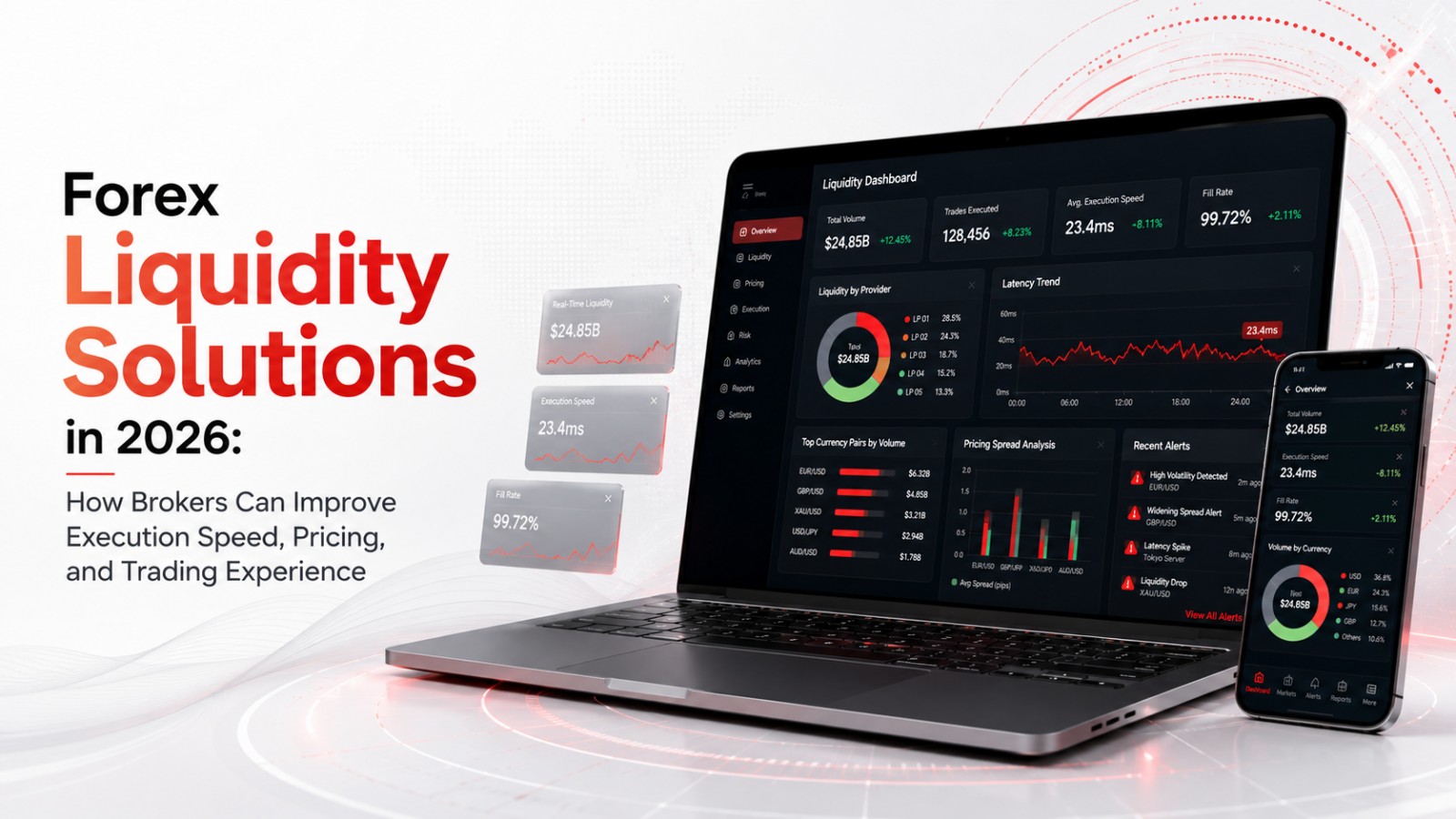
- Real-Time Monitoring and Automated Adjustments: Modern liquidity platforms provide dashboards displaying live spread changes, latency measurements, and provider performance. Automated rules can redirect trading flow when a liquidity source shows slower execution, wider spreads, or reduced market depth.
Common Challenges Brokers Face with Forex Liquidity
Even with advanced technology, brokers must address several liquidity-related challenges.
- Market Volatility and Spread Expansion: During major economic releases or unexpected geopolitical events, liquidity can decline rapidly, leading to wider spreads and increased slippage.
- Managing Toxic Trading Flow: Certain high-frequency strategies may exploit pricing delays or inefficient execution paths. Brokers need sophisticated analytics to identify these patterns and manage exposure appropriately.
- Balancing Cost and Execution Quality: The cheapest liquidity provider does not always offer the best trading conditions. Brokers must evaluate total execution quality, including spread stability, fill speed, and reliability.
How to Choose the Right Forex Liquidity Solutions Provider
Selecting a liquidity technology partner requires evaluating both liquidity access and infrastructure capabilities.
Brokers should consider:
- Number and quality of liquidity connections
- Aggregation technology
- Execution speed and latency performance
- MT4/MT5 and FIX API compatibility
- Real-time analytics and reporting
- Risk management capabilities
- Scalability for future trading volume growth
A well-designed liquidity infrastructure enables brokers to provide institutional-quality trading conditions while maintaining operational efficiency.
Conclusion
As the forex industry becomes increasingly technology-driven, brokers must treat liquidity infrastructure as a strategic advantage rather than a basic operational requirement. Advanced Forex Liquidity Solutions in 2026 combine multi-provider access, intelligent routing, real-time analytics, and low-latency execution to deliver superior trading conditions.
Brokers that invest in strong liquidity management for forex brokers can reduce execution issues, improve pricing competitiveness, manage trading risks effectively, and provide a better experience for their clients.
FXDS delivers advanced forex brokerage technology solutions designed to help brokers optimize liquidity, manage risk, and build scalable trading operations for the future.
Frequently Asked Questions (FAQs)
Q1. What are Forex Liquidity Solutions?
Forex Liquidity Solutions are technologies and services that provide brokers access to multiple liquidity sources, enabling better pricing, faster execution, improved market depth, and enhanced trading conditions.
Q2. Why are multiple forex liquidity providers important?
Multiple forex liquidity providers create competition between price streams, helping brokers achieve tighter spreads, improved execution quality, and greater stability during volatile market conditions.
Q3. What is low latency forex execution?
Low latency forex execution is the process of executing trading orders with minimal delay. Faster execution reduces slippage and provides traders with more accurate pricing.
Q4. How does liquidity management help forex brokers?
Liquidity management helps brokers monitor execution quality, optimize provider performance, control risk exposure, and maintain competitive trading conditions.
Q5. What is liquidity aggregation in forex trading?
Liquidity aggregation combines price feeds from multiple liquidity providers into a single pool, allowing brokers to deliver the best available prices to traders.
Q6. Can AI improve forex liquidity management?
Yes. AI-powered analytics can analyze execution data, identify inefficient liquidity sources, detect toxic flow, and automate execution optimization decisions.
Q7. What should brokers look for in a forex liquidity provider?
Brokers should evaluate pricing consistency, execution speed, market depth, technology compatibility, reporting tools, and reliability during volatile market conditions.