
Speed is currency in forex. A trader submitting an order expects execution in milliseconds, and when that doesn’t happen, trust erodes fast. For brokers, that trust translates directly into retention, reputation, and revenue. What most people underestimate is how many execution problems trace back not to market conditions, but to avoidable mistakes made during initial MT4 server setup.
Why MT4 Server Configuration Matters
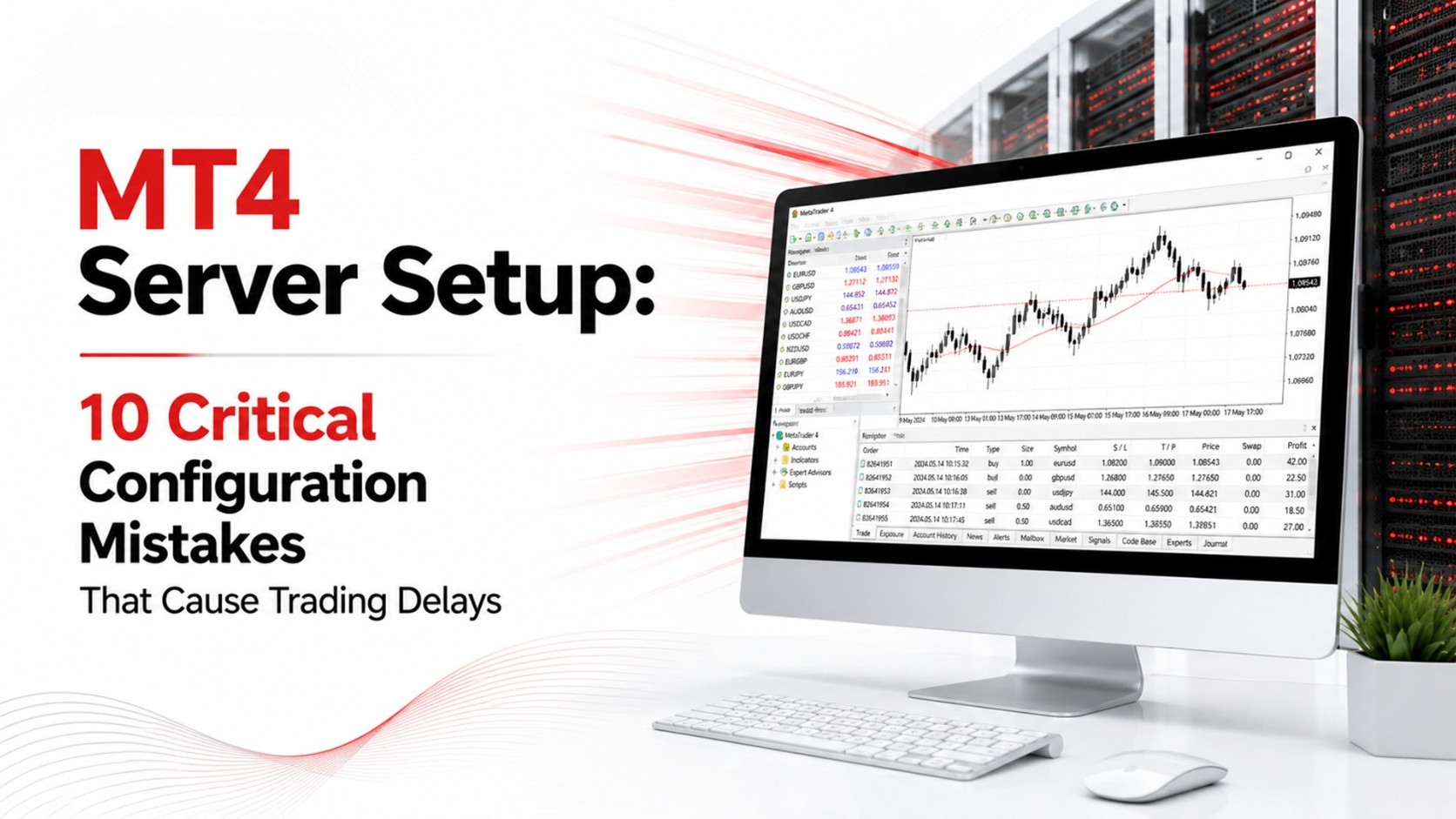
MT4 remains the most widely deployed retail trading platform in the world. It’s stable, widely understood, and deeply integrated into the forex broker ecosystem but it performs only as well as the infrastructure supporting it.
A poorly configured MT4 environment creates friction at every layer of the trading cycle. Price feeds arrive late. Orders queue instead of execute. Platforms lag during news releases. The ten mistakes below represent the most common configuration failures across broker deployments. All of them are preventable.
10 Critical Configuration Mistakes
1. Wrong Server Location:
Choosing a data center based on where the broker is headquartered rather than where liquidity providers operate is one of the most damaging early decisions a broker can make. Physical distance creates latency that compounds on every trade cycle. Co-locate as close as possible to LP infrastructure, typically in major financial hubs like LD4 in London or NY4 and NY5 in New Jersey.
2. Weak Hosting Infrastructure:
Shared hosting is not appropriate for production MT4 deployments. CPU contention and memory limitations degrade platform responsiveness precisely when volume is highest. MT4 demands dedicated resources, predictable I/O performance, and the ability to scale without disruption.
3. Poor Data Center Selection:
Not all data centers are equal. Power redundancy, cooling infrastructure, and network peering all affect latency and uptime. Forex trading infrastructure needs carrier-neutral facilities with multiple upstream providers and documented failover procedures.
4. Bridge Configuration Mistakes:
The bridge connecting MT4 to the liquidity provider is among the most technically sensitive components in the stack. Misconfigured execution modes, incorrect symbol mapping, or wrong lot size multipliers can generate requotes, partial fills, or silent execution failures. Precise alignment between MT4 symbol conventions, LP instrument identifiers, and execution parameters is essential.
5. Excessive Plugin Usage:
Every plugin consumes CPU cycles and memory. Too many plugins, especially poorly written third-party ones, create performance overhead and instability. Audit everything in the environment. Disable anything that is not actively earning its resource cost. Legacy plugins that predate the current configuration should be removed entirely.
6. Liquidity Feed Problems:
A clean, stable price feed is the foundation of everything. When the LP connection drops or delivers irregular tick data, traders see stale quotes and pending orders execute at unexpected prices. Feed resilience requires primary and backup connection configurations, proper reconnection logic, and ongoing monitoring. Treating the LP connection as set-it-and-forget-it is a recurring source of execution quality complaints.
7. Database Performance Issues:
MT4 writes significant data volumes in real time trade history, tick data, account records, and logs. Without disk I/O optimization, log rotation, and periodic maintenance, the database layer becomes a bottleneck. Brokers often discover that database bloat is a primary contributor to the latency their traders are experiencing.
8. Backup Configuration Failures:
A misconfigured backup that has not been tested is not a backup. MT4 server setup requires scheduled backups of configuration files, trade history, and account data, with verified restore procedures tested regularly. Brokers without tested recovery workflows are exposed to potentially irrecoverable data loss during hardware failures.
9. Security Configuration Errors:
Open ports that serve no purpose, unchanged default credentials, missing firewall rules, and unprotected admin interfaces all represent exploitable gaps. A compromised MT4 environment can expose client data, manipulate trading conditions, or take the entire platform offline. Security hardening must be part of initial deployment, not an afterthought.
10. Lack of Monitoring Systems:
Deploying without comprehensive monitoring is perhaps the single most operationally damaging mistake. Without visibility into CPU load, execution latency, feed connection status, and error logs, problems go undetected until traders notice them. Monitoring systems that alert on anomalies before they become outages allow teams to resolve issues proactively, not reactively after a trader complaint.
Warning Signs Your MT4 Environment Needs Attention
Execution delays that appeared recently, price feed freezes during high-impact news, platform unresponsiveness at market open, and rising dealing desk tickets are all signals that something has degraded or was never configured correctly.
Login delays suggest network or resource issues at the server level. Inconsistent spreads often trace back to bridge problems. A spike in order rejections is usually an execution parameter issue waiting to be diagnosed. None of these symptoms resolve on their own; they escalate until the underlying problem is fixed.
Building a Reliable MT4 Configuration
Before going live, every component should be tested under realistic load conditions. Bridge behavior should be validated across all instruments. Feed connections should be stress-tested through simulated volatility scenarios. Monitoring should be verified before the first live trader connects.
For brokers already in production, a configuration audit across these ten areas provides a clear baseline. Most execution quality issues trace to two or three specific gaps, making remediation considerably more manageable than a full infrastructure overhaul.
Conclusion
MT4 server setup is a business decision. Execution quality, platform stability, and trader experience are direct products of how well the environment is configured and maintained. The ten mistakes outlined here are avoidable with the right knowledge and processes. Brokers seeking reliable forex broker solutions understand that cutting corners on infrastructure always carries a higher long-term cost than investing in a properly optimized setup from the start.
Working with experienced providers of FX Dealing Solutions ensures that bridge configuration, liquidity feed management, security hardening, and monitoring are handled with the technical precision these systems demand. Accessing that expertise early is nearly always more economical than addressing the consequences of getting it wrong. For brokers building new deployments or improving existing ones, the right infrastructure partnership is not just a technical decision, it is a competitive advantage.