Launching a brokerage in 2026 is nothing like it was five years ago. The bar has risen significantly, and the firms that succeed are not just the ones with a license and a platform login. They are the ones that invested in a solid broker trading platform setup from day one. Infrastructure is no longer a backend consideration. It is the foundation that determines how fast you launch, how well you scale, and how effectively you manage risk from the moment you go live.
Why Broker Trading Platform Setup Matters More in 2026
The forex and multi-asset trading landscape has become more competitive and more scrutinized than at any point in its history. Retail traders now have access to sophisticated tools and high expectations around execution quality, platform stability, and support responsiveness. Regulatory environments across major jurisdictions have also tightened, adding compliance complexity that most startups underestimate.
Speed of execution matters enormously. A delay of even a few milliseconds in order routing can result in trader complaints, negative reviews, and churn at a scale that is difficult to recover from early on. Traders now compare platforms critically, and platforms that perform poorly under volume get abandoned quickly.
Scalability is another pressure point. A broker that launches with infrastructure built for 200 concurrent users will hit walls the moment traction builds. Rebuilding infrastructure mid-operation is expensive, disruptive, and risky. The right setup anticipates growth, not just launch day.
Core Infrastructure Components That Drive Modern Brokerages
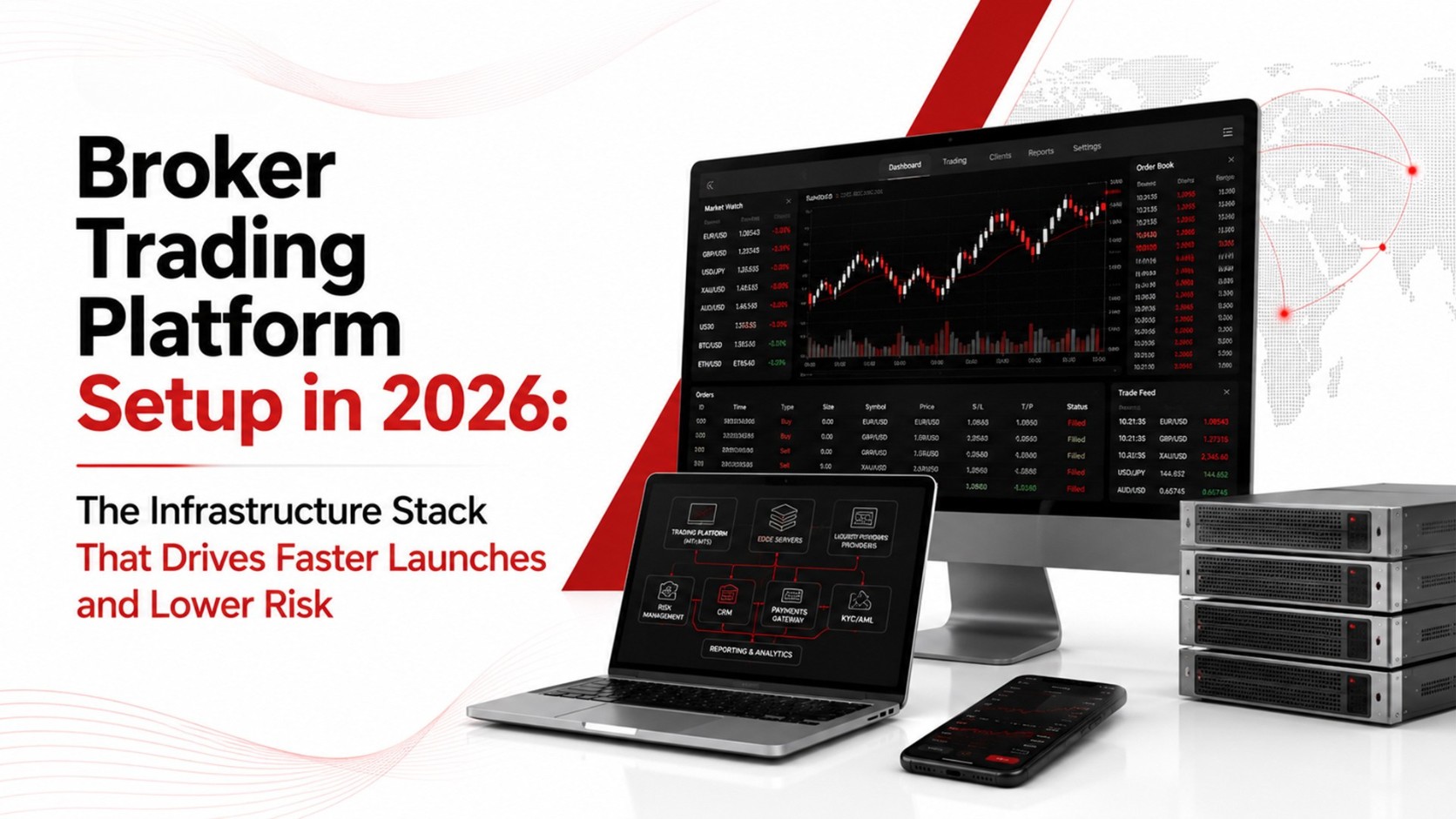
A modern brokerage is a collection of interdependent systems. Each one has to work independently and integrate cleanly with the others. Here is what that stack looks like in practice.
Trading Platform Technology
MT4 and MT5 remain the dominant platforms in retail and institutional forex. MT4 Server setup services continue to serve brokers targeting experienced retail traders who are comfortable with its interface and algo ecosystem. MT5 setup services are increasingly favored by brokers building multi-asset offerings, given the platform’s support for stocks, futures, and options alongside forex. The choice between them is not arbitrary. It depends on your target client base, asset classes, and long-term product roadmap.
Trading Servers
Server infrastructure underlies everything. Trading server setup requires careful attention to latency, geographic proximity to liquidity, redundancy, and failover capability. A trading server that goes down during a high-volatility news event is not just a technical issue. It is a regulatory and reputational one. Reliable broker infrastructure means having servers with failover configurations, ideally in proximity to major financial data centers.
CRM Systems
Forex CRM solutions are not just for managing leads. A well-integrated CRM handles client onboarding, KYC document tracking, account tier management, communication logs, and retention workflows. Brokers that use disconnected or generic CRM tools spend too much manual effort on tasks that should be automated. A purpose-built forex CRM is a direct efficiency driver.
Liquidity Provider Integration
Liquidity provider integration is what determines how competitive your spreads are and how cleanly orders are filled. Working with a reliable liquidity provider who can connect cleanly to your trading infrastructure is a technical and commercial decision in equal measure. Forex liquidity solutions need to be matched to your trading volumes, instrument offering, and the execution model you run, whether that is STP, ECN, or a hybrid desk approach.
Risk Management Systems
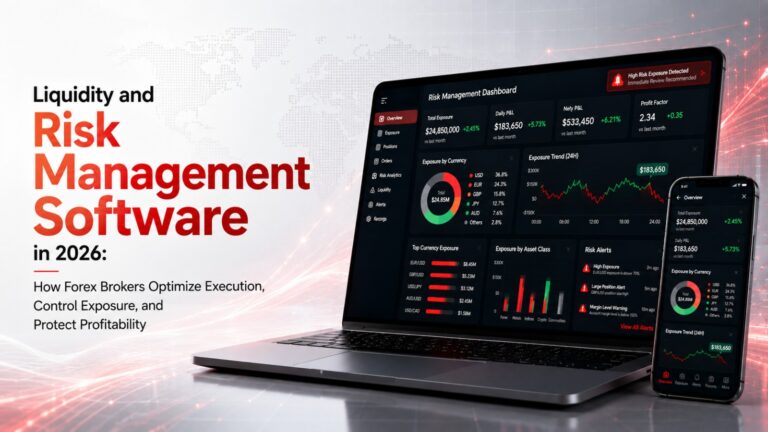
The Forex risk management solutions are what protect your business when markets move sharply or when client behavior deviates from expected patterns. A-book and B-book operations both require different risk controls. Having real-time exposure monitoring, automated hedging triggers, and dealer override tools built into your infrastructure is essential for any serious brokerage operation. Without it, risk accumulates silently until it cannot be ignored.
Back Office and Dealer Management
Broker back office solutions handle the financial operations layer: deposits, withdrawals, reconciliation, commissions, rebates, and financial reporting. These systems need to connect directly to your trading platform and CRM to avoid manual data reconciliation. Forex dealer management tools give your dealing team real-time visibility into positions, exposure, and client activity, enabling faster and more informed decisions on how to route and manage flow.
Client Portal and Compliance Reporting
A professional client portal improves the onboarding experience and reduces support load. Reporting systems built for compliance ensure that you can respond quickly to regulatory requests and maintain audit trails without scrambling through disconnected data sources.
How the Right Infrastructure Reduces Brokerage Risk
Brokerage risk is not just market risk. It spans execution, operations, technology, compliance, and data security. Each one is addressable at the infrastructure level.
Execution issues, like slippage, requotes, and order rejections, often trace back to poor liquidity connectivity or underpowered trading servers rather than market conditions. Downtime risk is reduced through redundant server architecture and load-balanced deployments. Security risks require multi-layer access controls, encrypted data pipelines, and intrusion monitoring baked into the infrastructure from the start, not added as an afterthought.
Compliance risk, often overlooked by startups, is significantly reduced when your back office and reporting systems are built to produce audit-ready records automatically. Firms that rely on spreadsheets and manual reconciliation face exposure every time a regulator asks a question.
Operational inefficiencies, such as manual client onboarding steps or disconnected data across CRM and trading platforms, create delays, errors, and staff overhead that compound as the business grows. Integrated forex brokerage technology addresses this by treating every system as part of a connected whole.
Faster Launches Depend on Technology Integration
One of the most consistent advantages available to new brokers is the use of prebuilt broker white label solutions combined with integrated infrastructure stacks. Rather than sourcing, configuring, and integrating each system independently, white label solutions give brokers a preconfigured foundation that is tested, connected, and ready to customize.
Brokerage setup services that provide an end-to-end stack, from trading platform to CRM to back office to liquidity, compress deployment timelines significantly. A standalone broker building from scratch might spend six to nine months in setup. A broker using integrated forex startup solutions can often reach launch in a fraction of that time, with lower technical risk at every step.
The key word is integration. A CRM that does not talk to your trading platform creates manual work. A trading platform that is not cleanly connected to your liquidity layer creates execution gaps. Preintegrated stacks eliminate these friction points before they become problems.
Choosing a Broker Technology Partner
Not all broker technology providers are equal. The decision is worth taking seriously because the wrong partner creates compounding problems that are difficult and expensive to unwind.
Start with experience. A provider that has set up and supported multiple live brokerages understands the operational edge cases that a newer provider simply will not anticipate. Ask for specific examples of infrastructure they have built and supported.
Support matters as much as the initial setup. Brokerage infrastructure requires ongoing maintenance, updates, and incident response. A provider that is reachable and responsive during a technical crisis is worth far more than one that is excellent during the sales process and slow afterward.
Evaluate scalability explicitly. Will their infrastructure handle ten times your current volume without a full rebuild? What does the upgrade path look like? These are questions that affect you in twelve to eighteen months, not just on launch day.
Customization capability is also worth examining. Your brand, your compliance requirements, and your target market may require adjustments that a rigid provider cannot accommodate. A flexible broker technology provider that can adapt to your needs without starting from scratch every time is a long-term asset.
A well-designed broker trading platform setup is not a cost center. It is the operational foundation that determines how competitive you are, how quickly you can serve clients, and how effectively you can manage the risks that come with running a financial services business. In 2026, the brokers that win are the ones that treat infrastructure as a strategic decision, not a procurement exercise.
Frequently Asked Questions
Q1. What is Broker Trading Platform Setup?
Broker Trading Platform Setup is the process of configuring trading platforms, servers, liquidity connections, CRM, risk management tools, and back office systems to build a stable, fully operational brokerage infrastructure.
Q2. How long does it take to launch a forex brokerage?
Launching a forex brokerage typically takes 8–16 weeks using white label solutions, while building infrastructure independently can take 6–12 months or more depending on licensing and integrations.
Q3. Why is liquidity integration important for brokers?
Liquidity integration improves trade execution quality, tighter spreads, better order fills, and reduced slippage, helping brokers deliver reliable trading experiences and maintain long term client trust.
Q4. What technology is required to start a brokerage in 2026?
A brokerage in 2026 requires MT4 or MT5 platforms, trading servers, liquidity connectivity, CRM software, risk management systems, client portals, and compliance reporting tools.
Q5. How can broker infrastructure reduce operational risks?
Strong broker infrastructure reduces operational risks through server redundancy, real time risk monitoring, automated reconciliation, compliance systems, and reliable liquidity integration for stable execution.