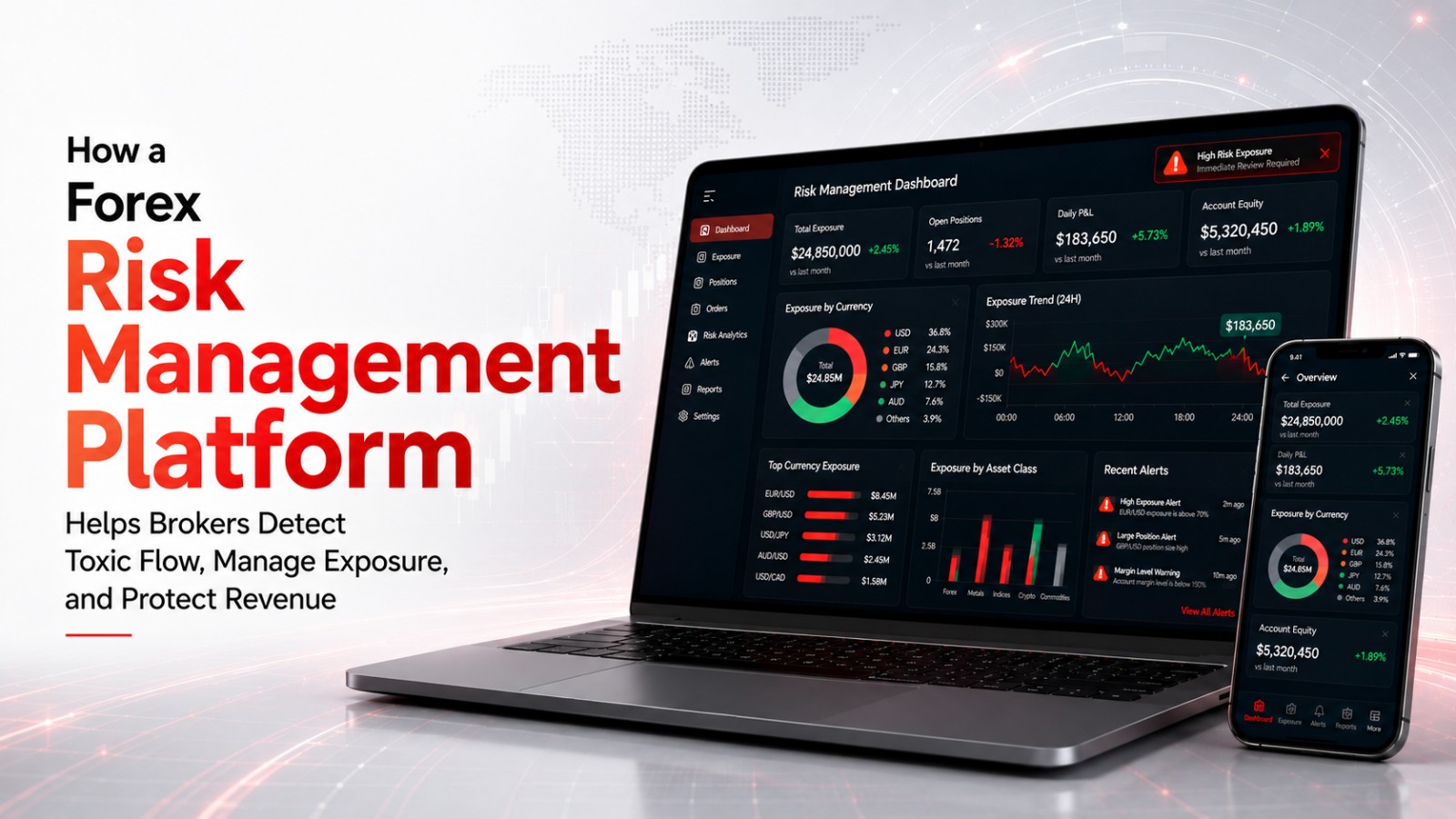
For a forex broker, managing market exposure is not just about reducing losses—it is a critical part of maintaining stable profitability, competitive spreads, and efficient liquidity management. With the growth of algorithmic trading, high-frequency strategies, and sophisticated arbitrage techniques, brokers face increasing pressure to identify harmful trading activity before it impacts their revenue.
A modern Forex Risk Management Platform provides brokers with real-time visibility into client behavior, exposure levels, liquidity performance, and potential toxic flow. Instead of relying on manual monitoring or delayed reports, brokers can make faster risk decisions, automate hedging strategies, and maintain a balanced trading book.
This article explores how advanced forex risk technology helps brokers detect toxic flow, manage trading exposure, improve operational efficiency, and create a more sustainable brokerage model.
What Is a Forex Risk Management Platform?
A Forex Risk Management Platform is specialized software designed to help brokers monitor, analyze, and control the financial risks associated with client trading activity. It collects real-time trading data from platforms such as MT4 and MT5, evaluates client profitability patterns, measures exposure, and helps dealers take appropriate actions.
Unlike basic reporting tools, advanced Forex broker risk management software combines live analytics, automation, and intelligent rule-based controls to help brokers manage thousands of positions across multiple currency pairs and CFDs.
A robust platform typically provides:
- Real-time exposure monitoring
- Client profitability and behavior analysis
- Toxic flow identification
- Automated A-Book and B-Book execution management
- Liquidity provider performance tracking
- Hedging and risk allocation tools
- Custom alerts and risk thresholds
These capabilities allow brokers to maintain better control over their trading environment and respond quickly to changing market conditions.
Understanding Toxic Flow and Why It Is a Major Concern for Forex Brokers
Toxic flow refers to trading activity that consistently exploits weaknesses in a broker’s execution infrastructure, pricing delays, or liquidity arrangements. It is often generated by highly sophisticated traders, high-frequency algorithms, latency arbitrage systems, or traders using advanced execution strategies.
Although every profitable client is not considered toxic, certain trading patterns can create disproportionate risk for a brokerage.
Common Signs of Toxic Trading Flow
A Forex Risk Management Platform can identify indicators such as:
- Consistent profits generated from latency differences
- Extremely short holding periods
- High-frequency order placement and cancellation
- Trading around major economic announcements
- Abnormal win rates compared to average traders
- Exploitation of price feed delays
By recognizing these behaviors early, brokers can adjust execution strategies, modify routing rules, or hedge exposure more effectively.
How a Forex Risk Management Platform Detects Toxic Flow in Real Time
Traditional end-of-day reports are no longer enough in a fast-moving forex market. Modern brokers require real-time intelligence that highlights abnormal trading activity as it happens.
1. Advanced Trade Analytics and Client Segmentation
Risk platforms categorize traders based on profitability, trading style, holding duration, instrument preference, and risk profile.
For example, a broker can identify whether a client behaves like a retail trader, an algorithmic trader, or a potential latency arbitrage participant. This segmentation allows dealing desks to apply customized risk rules.
2. Latency and Execution Quality Monitoring
Advanced systems analyze execution speed, price deviations, and order patterns to identify traders taking advantage of delayed quotes.
This helps brokers protect their infrastructure and maintain healthier relationships with liquidity providers.
3. Automated Alerts and Risk Rules
A sophisticated broker risk monitoring system can send instant notifications when predefined risk parameters are breached.
Examples include:
- A client exceeding profitability thresholds
- A currency pair reaching dangerous exposure levels
- Sudden increases in trading volume
- Unusual trading behavior during volatile market conditions
Automation allows risk teams to respond within seconds instead of reviewing problems after losses have already occurred.
Managing Broker Exposure with Real-Time Risk Analytics
Exposure management is one of the most valuable functions of a Forex Risk Management Platform.
Forex brokers constantly balance long and short positions across multiple instruments. If exposure becomes concentrated in one direction, market movements can significantly affect the broker’s financial position.
1. Monitoring Net and Gross Exposure
A professional risk management system provides a clear view of:
- Total client exposure by asset class
- Net long and short positions
- Symbol-level and account-level risk
- Unrealized profit and loss
- Historical exposure trends
These insights help brokers make informed decisions about internalization, hedging, or changing execution models.
2. Intelligent A-Book and B-Book Risk Management
Many modern brokerages use hybrid execution models combining A-Book and B-Book strategies.
A Forex Risk Management Platform helps determine which trades should be passed to liquidity providers and which can be retained internally based on factors such as client behavior, profitability history, and current market conditions.
This improves revenue optimization while maintaining acceptable risk levels.
3. Improving Liquidity Management and Execution Performance
Liquidity quality directly impacts a broker’s profitability and client experience.
Risk management platforms allow brokers to evaluate liquidity providers based on:
- Execution speed
- Fill ratios
- Slippage analysis
- Pricing quality
- Cost of execution
By comparing liquidity performance, brokers can optimize order routing and build stronger relationships with reliable liquidity providers.
Key Benefits of Using Forex Risk Management Solutions
Investing in professional forex risk technology provides several strategic advantages:
- Better Revenue Protection: Early identification of harmful trading patterns reduces unnecessary losses and helps maintain consistent profitability.
- Faster Decision-Making: Real-time dashboards provide dealers and risk managers with immediate visibility into changing market conditions.
- Increased Operational Efficiency: Automation reduces manual monitoring, allowing risk teams to focus on strategic decisions.
- Enhanced Scalability: As trading volume grows, brokers can manage more clients, instruments, and liquidity connections without significantly increasing operational complexity.
Future Trends in Forex Brokerage Risk Management
The future of forex risk management is moving toward greater automation and predictive analytics.
Artificial intelligence and machine learning models are increasingly being used to identify unusual trading patterns, forecast exposure risks, and improve execution decisions.
Cloud-based analytics, deeper liquidity intelligence, and smarter A-Book/B-Book optimization will continue to help brokers maintain profitability in an increasingly competitive market.
Brokers that invest in advanced risk infrastructure today will be better positioned to handle growing trading volumes and more sophisticated market participants.
Conclusion
As forex markets become more technology-driven, relying on manual risk monitoring is no longer sufficient. A modern Forex Risk Management Platform gives brokers the tools to detect toxic flow, monitor exposure in real time, optimize A-Book and B-Book execution, and protect long-term revenue.
For brokers aiming to improve profitability, strengthen liquidity management, and build a scalable operation, implementing advanced risk analytics is a strategic necessity.
FXDS provides sophisticated forex risk management solutions designed for brokers seeking greater visibility, smarter execution decisions, and stronger control over trading risk. Explore FXDS risk technology to build a more resilient brokerage operation.
Frequently Asked Questions (FAQs)
Q1. What is a Forex Risk Management Platform?
A Forex Risk Management Platform is a technology solution that helps brokers monitor trading activity, control exposure, detect toxic flow, manage liquidity, and optimize profitability.
Q2. How does a broker identify toxic flow?
Brokers identify toxic flow by analyzing trading patterns such as latency arbitrage, abnormal profitability, high-frequency trading behavior, and unusual execution patterns.
Q3. Why is real-time exposure monitoring important for forex brokers?
Real-time monitoring helps brokers react quickly to changing market conditions and prevent excessive losses caused by unbalanced positions.
Q4. What is the difference between A-Book and B-Book risk management?
A-Book execution sends trades to external liquidity providers, while B-Book execution allows brokers to internalize client trades. Many brokers use a hybrid model to balance risk and profitability.
Q5. Can Forex Risk Management Software improve broker profitability?
Yes. It helps brokers reduce unnecessary exposure, identify harmful trading activity, optimize liquidity usage, and make more profitable execution decisions.
Q6. Which trading platforms integrate with risk management solutions?
Many advanced solutions integrate with platforms such as MetaTrader 4 (MT4), MetaTrader 5 (MT5), and other institutional trading infrastructures.