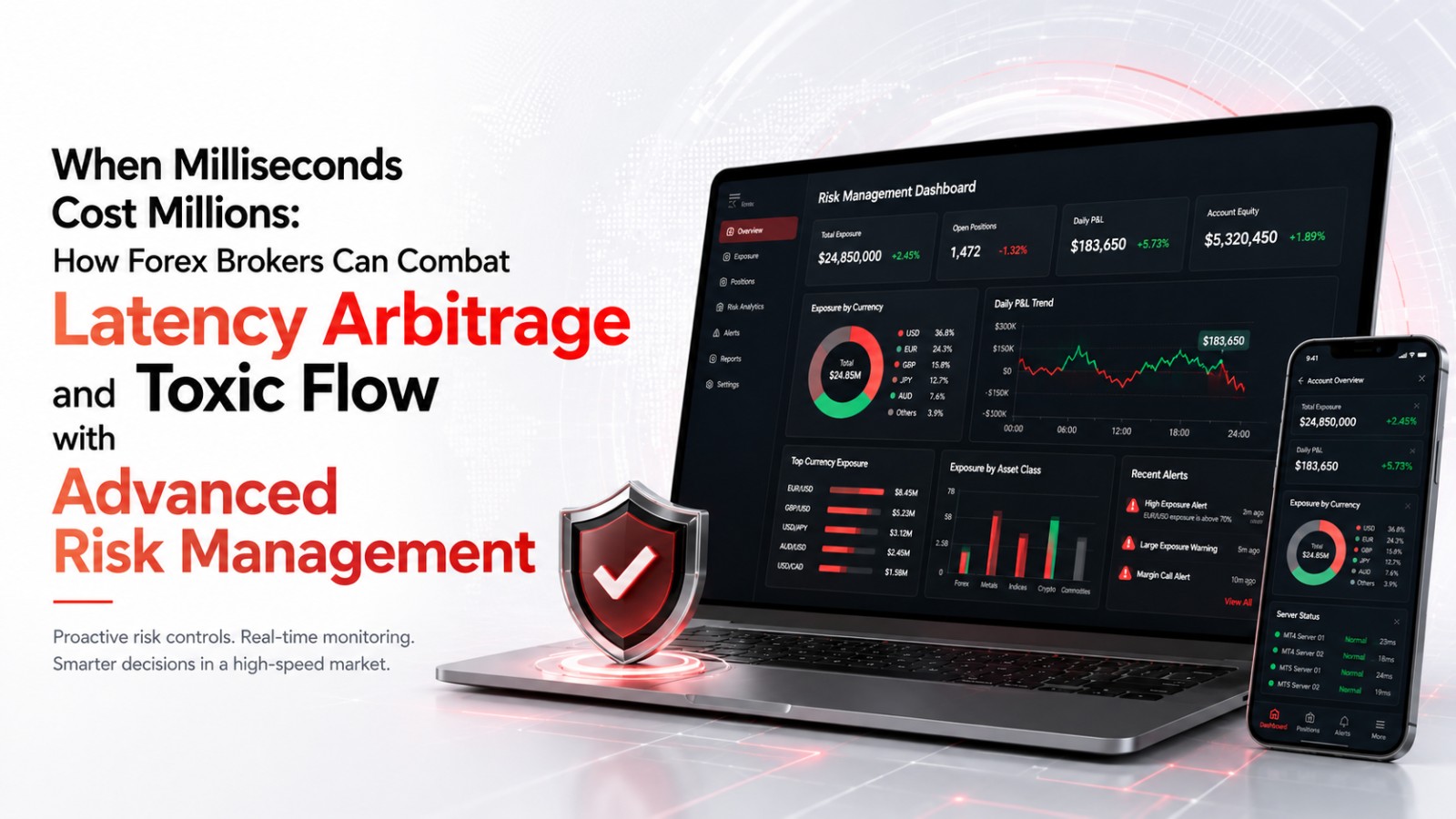
In the forex market, where thousands of orders can be executed within a fraction of a second, even a small delay in price execution can create significant financial exposure for brokers. High-frequency traders and sophisticated algorithms continuously search for execution inefficiencies, exploiting milliseconds of latency to generate risk-free profits at the broker’s expense.
This challenge has made Advanced Risk Management an essential component of modern brokerage operations. Traditional monitoring methods and manual intervention are no longer sufficient to identify aggressive trading patterns, latency arbitrage strategies, and toxic flow in forex markets.
Today’s successful forex brokers rely on intelligent forex risk management solutions that provide real-time analytics, automated decision-making, and dynamic exposure control. By identifying harmful trading activity before it affects profitability, brokers can maintain healthier client books, improve liquidity relationships, and operate with greater confidence in increasingly competitive markets.
Understanding Latency Arbitrage in Forex
Latency arbitrage in forex is a trading strategy where traders exploit the time difference between a price change in the broader market and the delayed price available from a broker or liquidity provider.
For example, a major economic announcement may cause EUR/USD prices to move rapidly across institutional markets. If a broker’s price feed updates milliseconds slower than the market, an advanced trading algorithm can execute trades using outdated prices and immediately profit from the discrepancy.
Although latency arbitrage is not necessarily illegal, it creates an uneven trading environment and can lead to substantial losses for brokers.
Common indicators of latency arbitrage include:
- Consistent profits achieved during high-volatility events.
- Extremely short trade durations.
- High-frequency trading activity with precise entry timing.
- Abnormally high win rates compared with average retail traders.
- Concentrated activity around market-moving news releases.
Without proper detection systems, repeated latency arbitrage can silently drain broker profitability over time.
What Is Toxic Flow in Forex and Why Is It Dangerous?
Toxic flow in forex refers to trading activity that creates an unfavorable risk profile for brokers or liquidity providers. It typically originates from traders using sophisticated algorithms, ultra-low latency systems, or strategies designed to capitalize on pricing inefficiencies.
Not every profitable trader generates toxic flow. The distinction lies in the impact of the trading behavior on execution quality, liquidity costs, and the broker’s ability to manage exposure.
Examples of toxic flow include:
- Latency arbitrage.
- News trading with ultra-fast execution.
- High-frequency scalping.
- Quote stuffing or excessive order activity.
- Strategies exploiting delayed or inconsistent pricing.
Unchecked toxic flow can create several operational problems, including increased hedging costs, reduced profitability, and deteriorating relationships with liquidity providers. Some liquidity providers may widen spreads, increase rejection rates, or impose stricter trading conditions when a broker consistently sends harmful order flow.
Advanced Risk Management: The First Line of Defense Against Toxic Trading
Modern Advanced Risk Management systems give brokers the ability to move beyond simple exposure tracking. They analyze trading behavior, liquidity performance, execution patterns, and market conditions in real time.
An effective risk management platform can identify suspicious activity within milliseconds and allow brokers to take automated corrective actions before losses accumulate.
Real-Time Risk Monitoring for Forex Brokers
Real-time risk monitoring for forex brokers provides complete visibility into client activity and market exposure.
Key capabilities include:
- Monitoring client profitability and trading behavior.
- Detecting abnormal execution patterns.
- Tracking exposure by symbol, client group, and strategy type.
- Measuring latency between price feeds and execution.
- Generating alerts for unusual trading activity.
Instead of reviewing reports after losses have occurred, brokers can respond immediately to emerging threats.
Automated A-Book and B-Book Management for Better Risk Control
One of the most effective forex risk management solutions involves intelligent allocation of client trades between A-Book and B-Book models.
A-Book execution routes trades directly to liquidity providers, transferring market risk outside the brokerage. B-Book execution allows the broker to internalize selected client trades.
Advanced systems use real-time analytics to determine the most appropriate execution path based on factors such as:
- Client Trading Behavior Analysis: Risk engines evaluate historical profitability, holding periods, trading frequency, and strategy characteristics. Traders showing signs of toxic behavior can be automatically routed to external liquidity.
- Exposure and Market Conditions: During periods of high volatility, risk parameters can adjust automatically to prevent excessive internal exposure.
This hybrid approach enables brokers to protect revenue while maintaining fair and efficient trade execution.
Liquidity Risk Management in Forex: Protecting Broker Relationships
Liquidity risk management in forex goes beyond obtaining multiple liquidity providers. Brokers must continuously analyze the quality and profitability of their liquidity connections.
Advanced analytics help brokers evaluate:
- Fill rates.
- Slippage patterns.
- Execution speed.
- Spread competitiveness.
- Profitability of each liquidity source.
By understanding which liquidity channels perform best under different market conditions, brokers can optimize routing decisions and reduce unnecessary trading costs.
Smart liquidity management also helps maintain stronger relationships with Tier-1 banks, prime brokers, and institutional liquidity providers.
Technologies Powering Modern Forex Risk Management Solutions
The latest generation of forex risk management solutions combines advanced technology with automated decision-making.
- Artificial Intelligence and Machine Learning: AI-driven systems analyze millions of trading data points to recognize patterns that may indicate toxic flow. Over time, these models improve detection accuracy and reduce false alerts.
- Real-Time Analytics Engines: High-speed analytics platforms process market data, client orders, and exposure information within milliseconds, allowing brokers to react before a small risk becomes a major financial event.
- Dynamic Rule-Based Automation: Risk managers can create automated rules based on predefined conditions. For example, a trader exhibiting latency arbitrage behavior can automatically be moved to a different execution stream or subject to adjusted risk controls.
Best Practices for Forex Brokers to Reduce Latency Arbitrage Risks
A strong defense against latency arbitrage requires a combination of technology, infrastructure, and operational discipline.
Successful brokers should:
- Use low-latency market data feeds.
- Continuously monitor execution delays.
- Segment clients based on trading behavior.
- Implement automated toxic flow management rules.
- Maintain diversified liquidity sources.
- Regularly analyze profitability by client and strategy.
The most effective brokers treat risk management as an ongoing process rather than a periodic review.
The Future of Advanced Risk Management in Forex Brokerage
As algorithmic trading continues to grow, latency-related risks and sophisticated trading strategies will become more common. Brokers relying on manual reporting and outdated systems may struggle to maintain profitability.
The future of advanced risk management lies in predictive analytics, AI-based risk scoring, automated liquidity optimization, and fully integrated real-time decision engines.
Brokers that invest in intelligent risk infrastructure today will be better positioned to control exposure, improve execution quality, and build sustainable long-term operations.
Conclusion
When milliseconds determine profitability, brokers cannot rely on outdated risk management methods. Latency arbitrage and toxic flow have transformed the way modern brokerage firms approach exposure control, liquidity management, and client segmentation.
By implementing Advanced Risk Management technologies with real-time monitoring, AI-driven analytics, automated A/B book management, and intelligent liquidity optimization, forex brokers can minimize losses, protect relationships with liquidity providers, and create a more resilient trading infrastructure.
For brokers seeking scalable and intelligent forex risk management solutions, adopting advanced risk technologies is no longer optional, it is a strategic requirement for long-term growth.
Frequently Asked Questions (FAQs)
Q1. What is latency arbitrage in forex?
Latency arbitrage in forex is a strategy where traders exploit delays between market price changes and a broker’s quoted prices, allowing them to trade at outdated prices for potential profit.
Q2. What is considered toxic flow in forex trading?
Toxic flow refers to trading behavior that negatively affects a broker’s profitability or liquidity relationships, often involving high-frequency strategies, latency exploitation, or aggressive news trading.
Q3. How can forex brokers detect toxic flow?
Forex brokers can detect toxic flow using advanced risk management systems that analyze execution speed, trade duration, profitability patterns, and abnormal trading behavior in real time.
Q4. Why is real-time risk monitoring important for forex brokers?
Real-time monitoring allows brokers to identify dangerous exposure, suspicious trading patterns, and liquidity issues before they cause significant financial losses.
Q5. What are the benefits of automated A-Book and B-Book management?
Automated A-Book and B-Book management helps brokers optimize trade routing, reduce risk exposure, improve profitability, and handle toxic traders more efficiently.
Q6. How does liquidity risk management help forex brokers?
Liquidity risk management helps brokers evaluate liquidity provider performance, reduce execution costs, improve order routing, and maintain stable market access during volatile conditions.
Q7. Can AI improve forex risk management?
Yes. AI can analyze large amounts of trading data, identify hidden risk patterns, detect toxic flow earlier, and support automated decision-making.