
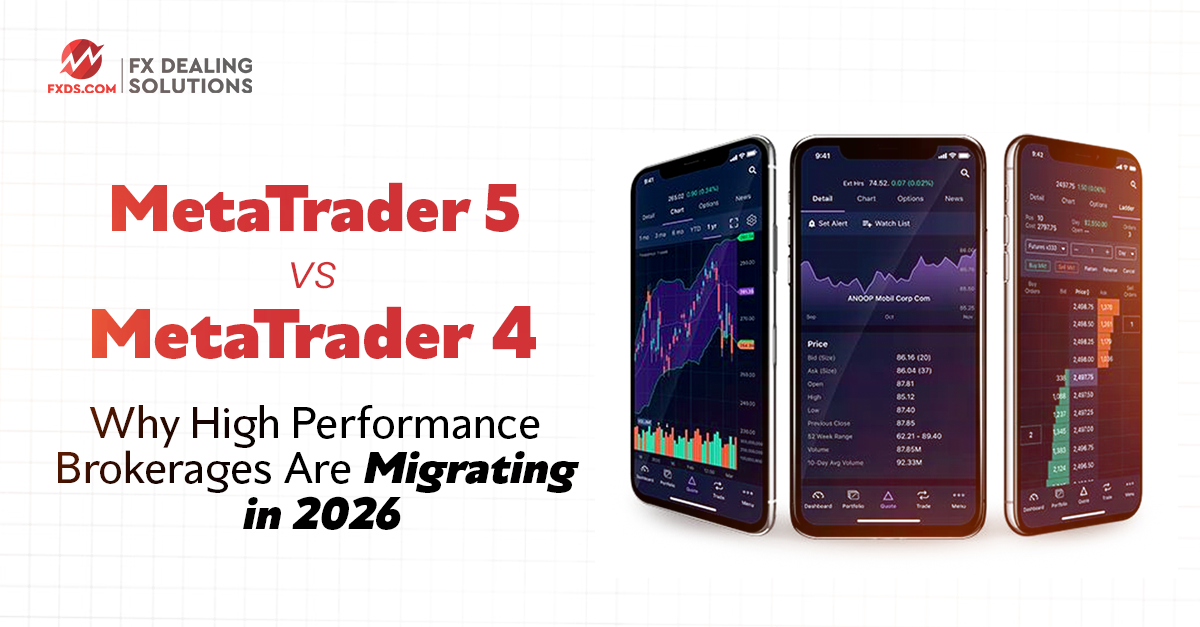
The brokerage industry is rapidly evolving, driven by technological advancements and increasing client expectations. In today’s competitive trading environment, execution speed, platform stability, and robust risk management tools are no longer optional—they are critical factors that determine a broker’s ability to operate efficiently and attract high-value clients. For over a decade, MetaTrader 4 (MT4) dominated the retail forex market, offering simplicity, reliability, and a large ecosystem of expert advisors. However, as trading demands grow, including the need for multi-asset support, faster execution, and advanced risk monitoring, many forward-looking brokerages are migrating to MetaTrader 5 (MT5). With its 64-bit multi-threaded architecture, enhanced scalability, and built-in risk management features, MT5 is designed to handle the complexities of modern trading.
This article provides a comprehensive comparison between MT4 and MT5, highlighting key differences in architecture, asset support, performance, and risk management. It also examines how these platforms impact brokerage operations, why upgrading to MT5 is becoming a strategic priority for high-performance brokerages in 2026, and how the right platform choice can drive growth, operational efficiency, and competitive advantage.
Why Trading Infrastructure Matters for Brokers
Brokerages today handle thousands of trades per second. Traders expect instant execution, stable servers, and access to multiple financial instruments. If a platform struggles during market volatility, brokers face slippage complaints, liquidity issues, and exposure risks.
This is where the MT4 vs MT5 debate becomes important. While MT4 helped launch the online forex trading industry, the demands of modern trading have exposed several limitations in its architecture.
Key Difference Between MT4 and MT5
| Feature | MetaTrader 4 (MT4) | MetaTrader 5 (MT5) | Impact for Brokers |
|---|---|---|---|
| Platform Architecture | 32-bit, single-threaded system; sequential task processing | 64-bit, multi-threaded system; processes multiple operations simultaneously | Faster order execution, better stability during volatility, ability to scale operations globally |
| Asset Class Support | Primarily forex; limited multi-asset support via plugins | Forex, stocks, commodities, futures, indices, crypto CFDs | Diversification increases trading volume, attracts wider trader base, boosts revenue streams |
| Order Management System | Simple order system focused on forex | Advanced order system; supports multiple order types, netting & hedging, improved trade reporting | Improved transparency, easier risk monitoring, faster execution logic |
| Server Performance & Latency | Can experience delays during high trading volume; sequential processing may slow servers | Multi-threaded processing, distributed server system, optimized memory usage | Lower execution times, improved platform stability, reduced operational pressure |
| Risk Management | Relies heavily on third-party plugins for exposure, client groups, and liquidity bridging | Built-in advanced risk management tools: real-time exposure monitoring, reporting, dealer controls, liquidity integration | Quicker decisions, accurate risk mitigation, reduced operational complexity |
| Scalability | Requires careful optimization and extra tools to handle large growth | Designed for enterprise-level expansion; supports thousands of concurrent traders, cloud deployment | Supports global expansion, lower infrastructure stress, efficient data processing |
| Technology Limitations | Limited architecture, higher dependency on plugins, reduced development updates, scaling challenges | Modern architecture, continuous updates, built for multi-asset scalability | Future-ready infrastructure, supports high-performance broker operations |
Why Brokers Are Migrating to MetaTrader 5 in 2026
The brokerage industry is rapidly evolving, and technology-driven trading platforms are becoming a key differentiator. Several industry trends are driving brokers to migrate from MetaTrader 4 (MT4) to MetaTrader 5 (MT5).
- Growing Demand for Multi-Asset Trading – Modern traders want access to forex, stocks, commodities, indices, futures, and crypto CFDs from a single platform. MT5 supports all these asset classes, while MT4 is primarily forex-focused.
- Need for Faster Execution – With increasing trading volumes and high-frequency trading strategies, brokers require low-latency execution. MT5’s 64-bit multi-threaded architecture ensures faster order processing and reduced slippage.
- Enhanced Compliance and Reporting – Regulatory requirements are more stringent than ever. MT5 offers advanced reporting tools and audit-ready features, making it easier for brokers to comply with local and international regulations.
- Advanced Risk Management Tools – MT5 comes with built-in real-time exposure monitoring, dealer controls, and liquidity management, addressing core operational challenges and minimizing financial risks.
- Long-Term Platform Sustainability – MT5 is designed for future growth, supporting enterprise-level scalability, cloud deployment, and multi-threaded operations. It provides a sustainable infrastructure for brokerages planning expansion in 2026 and beyond.
Startups often adopt MT5 from the beginning because it provides a future-ready platform without requiring extensive modifications. Established brokers are also gradually transitioning clients to MT5 while maintaining MT4 during the migration phase, ensuring a smooth client experience.
Core Operational Issues Solved by MT5
Migrating to MT5 addresses several challenges that brokerages face with MT4:
- Execution Delays During Volatility – MT5 processes multiple tasks simultaneously, reducing lag during peak trading periods.
- System Overload During High Trading Activity – Multi-threaded architecture ensures stability even with thousands of concurrent trades.
- Complex Risk Exposure Monitoring – Built-in tools allow brokers to monitor exposure in real time, improving decision-making.
- Limited Product Offerings – MT5 supports multiple asset classes, enabling brokerages to expand product lines and revenue streams.
- Data Processing Inefficiencies – Advanced reporting and analytics optimize operations and reduce dependency on third-party plugins.
By solving these issues, MT5 empowers brokers to deliver a seamless trading experience while maintaining operational stability and regulatory compliance.
Conclusion
The debate between MT4 and MT5 is no longer just about trading platforms. It is about infrastructure performance, scalability, and long term brokerage growth.
While MT4 played a historic role in the development of online forex trading, the industry is moving toward more advanced technology. MT5 delivers the architecture, flexibility, and risk management analytics needed for modern brokerage operations.
For brokers planning the next stage of growth in 2026 and beyond, adopting MT5 infrastructure can provide stronger stability, better execution, and a more competitive trading environment.